

Search has changed. Not slowly. Not subtly. Radically.
A few years ago, ranking on Google was the main game. Today, your audience might find you through a featured snippet, a voice assistant, or even an AI-generated answer that never shows traditional search results.
Here’s the thing: if your strategy still revolves only around classic SEO, you’re already behind.
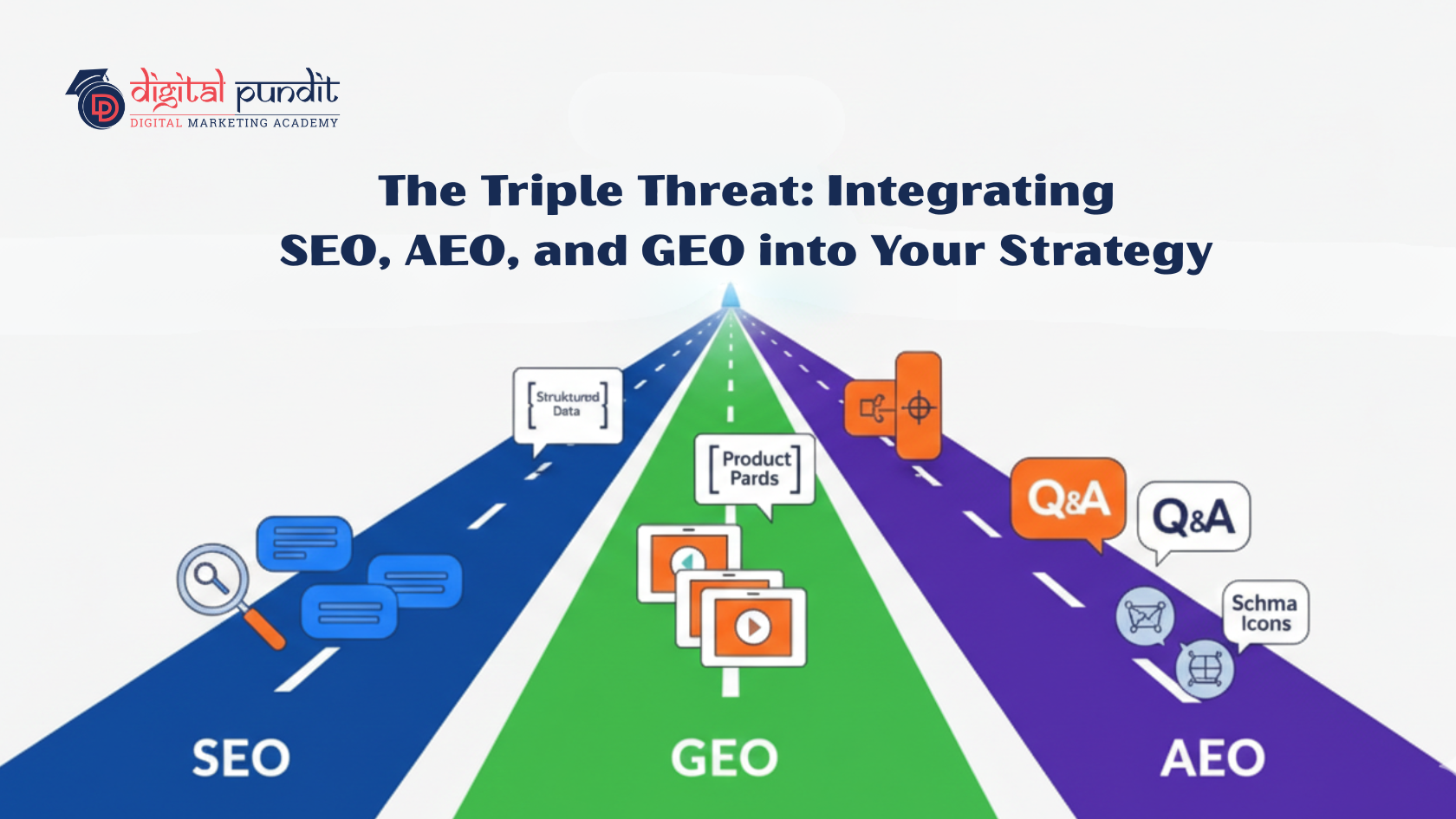
To win in 2026 and beyond, you need a triple-layered approach:
- SEO – Search Engine Optimization
- AEO – Answer Engine Optimization
- GEO – Generative Engine Optimization
Let’s break it down and see how you can integrate all three into one powerful, future-ready strategy.
Part 1: SEO – The Foundation You Still Can’t Ignore
SEO is not dead. It’s evolving.
Search Engine Optimization is still the backbone of online visibility. It ensures your website ranks on search engines like Google when someone types a relevant query.
But modern SEO isn’t about stuffing keywords and building random backlinks. It’s about intent, authority, and experience.
What Strong SEO Looks Like Today
- Search Intent Mapping
Every keyword falls into one of these buckets: informational, navigational, transactional, or commercial investigation.
If your content doesn’t match intent, rankings won’t convert. - Topical Authority
Instead of writing one article on a topic, build clusters.
For example, if you’re targeting the keyword digital marketing course, you shouldn’t just publish one page. You need:- A core landing page
- Blog posts on career scope
- Comparisons with MBA
- Salary insights
- Course syllabus breakdown
- Technical Health
- Fast loading speed
- Mobile optimization
- Clean internal linking
- Schema markup
- E-E-A-T Signals
Experience, Expertise, Authoritativeness, and Trustworthiness matter more than ever.
SEO builds visibility. But visibility alone isn’t enough anymore.
That’s where AEO comes in.
Part 2: AEO – Optimizing for Answers, Not Just Rankings
Answer Engine Optimization focuses on getting your content selected as a direct answer.
Think:
- Featured snippets
- People Also Ask
- Voice search results
- Instant answers
When someone asks, “Which digital marketing course is best after 12th?” Google often shows a short paragraph at the top. That’s AEO territory.
Instead of optimizing for clicks only, you optimize for extraction.
How AEO Works
Search engines now try to answer questions instantly. They scan structured, clear, authoritative content and pull out the best response.
To optimize for AEO:
- Use Question-Based Headings
Example:- What is the scope of a digital marketing course?
- Is digital marketing a good career after 12th?
- Give Direct, Clear Answers First
First 2–3 lines should directly answer the question.
Then expand. - Use Structured Formatting
- Bullet points
- Tables
- Short paragraphs
- Definitions
- Add FAQ Sections
Frequently Asked Questions increase your chances of appearing in snippets.
For example, if someone is confused about career paths after 12th, content like this becomes powerful:
https://digitalpundit.in/confused-about-the-best-courses-after-12th-commerce-science-or-skill-based-the-truth-nobody-tells-you/
This type of blog not only ranks but also answers real questions in a structured way. That’s where SEO and AEO overlap.
But now, there’s a third layer changing everything.
Part 3: GEO – The Rise of Generative Engine Optimization
This is the new frontier.
Generative Engine Optimization focuses on making your content visible and referenced in AI-generated answers from tools like:
- Chat-based search assistants
- AI-driven recommendation systems
- Generative search experiences
Users are no longer just “searching.” They are asking AI to explain, compare, and recommend.
And AI doesn’t simply list links. It summarizes from multiple sources.
So the real question is:
Is your content good enough to be quoted by AI?
What GEO Demands
- Depth Over Surface-Level Content
Thin content won’t make it. AI systems prioritize detailed, context-rich explanations. - Clear Brand Mentions
If your company name isn’t consistently associated with expertise in a topic, AI won’t confidently reference it. - Topical Consistency
If you talk about digital marketing once and random topics later, you won’t build authority. - Data-Driven Insights
AI favors content with:- Statistics
- Examples
- Structured comparisons
- Clear frameworks
Let’s make it practical.
If Digital Pundit wants to dominate in the digital marketing education space, it can’t just publish one landing page about a digital marketing course.
It needs:
- Career roadmap blogs
- Salary analysis posts
- Case studies
- Industry trend breakdowns
- Practical skill guides
When AI systems analyze content across the web, they detect patterns.
If Digital Pundit repeatedly demonstrates expertise in digital marketing education, it becomes a trusted source.
That’s GEO in action.
Why You Can’t Choose Just One
Here’s where most brands make mistakes.
They ask:
“Should we focus on SEO or AI visibility?”
Wrong question.
The correct approach is integration.
Let’s see how the three layers connect.
SEO Brings Traffic
It ensures your website appears in search results.
AEO Wins Featured Real Estate
It helps you own snippets and direct answers.
GEO Secures AI Mentions
It ensures your brand is part of AI-generated recommendations.
Together, they form a compounding system.
Ignore one, and you weaken the whole structure.
Building the Triple Threat Strategy Step-by-Step
Let’s make this actionable.
Step 1: Build Topic Clusters
Start with a core topic. For example: digital marketing course.
Create a central pillar page. Then build supporting articles:
- What is digital marketing?
- Career opportunities in digital marketing
- Salary after digital marketing course
- Digital marketing vs traditional marketing
- Best certifications in digital marketing
Interlink everything.
This strengthens SEO and builds topical authority for GEO.
Step 2: Convert Every Blog into an AEO Asset
After writing a blog:
- Add 5–7 FAQs
- Answer questions clearly in 40–60 words
- Use schema markup
Think beyond ranking. Think extraction.
Step 3: Strengthen Brand Authority
AI systems don’t trust anonymous content.
Make sure:
- Your brand name Digital Pundit appears consistently in educational, insightful contexts.
- You publish thought leadership content.
- You share original insights instead of generic summaries.
Authority is built through repetition and depth.
Step 4: Focus on Experience Signals
Search engines and AI models prefer content that reflects real experience.
For example:
Instead of saying
“Digital marketing has good scope.”
Say
“Over the past five years, demand for performance marketers has increased across e-commerce, fintech, and education sectors. Roles like SEO Specialist, Media Buyer, and Marketing Automation Expert are growing faster than traditional advertising jobs.”
Specific beats vague. Every time.
The Role of Educational Brands in the AI Era
Educational brands have a massive opportunity.
Students today don’t just search. They ask:
- Which course is best after 12th?
- Is digital marketing better than MBA?
- How much salary can I expect?
If your content answers these questions clearly, you win across SEO, AEO, and GEO.
It tackles confusion directly. That clarity improves snippet chances and AI references.
This is how a brand like Digital Pundit can position itself not just as a training institute, but as an authority in career guidance.
What This Really Means for Marketers
You can’t treat content like a checklist anymore.
Publishing 50 average blogs won’t help.
Publishing 10 strategic, structured, experience-driven pieces will.
Search is moving from:
Keywords → Questions → Conversations
And your content must evolve accordingly.
If you run an institute offering a digital marketing course, your strategy should look like this:
- Rank for course-related keywords (SEO)
- Answer career doubts in snippet-friendly formats (AEO)
- Build deep authority so AI tools reference your brand (GEO)
That’s the triple threat.
The Competitive Advantage of Acting Early
Most brands are still stuck in traditional SEO thinking.
That’s your opportunity.
If Digital Pundit integrates SEO, AEO, and GEO now:
- Organic traffic grows
- Snippet visibility increases
- AI recommendations start including the brand
- Trust compounds
And trust is the ultimate growth driver.
Because in education, people don’t buy courses.
They buy clarity. They buy direction. They buy confidence.
Final Thoughts
The digital landscape is not shrinking. It’s expanding.
Search engines are smarter. AI is more conversational. Users are more impatient.
You have two choices:
Stick to outdated SEO tactics and compete for shrinking attention.
Or build a layered strategy that combines:
SEO for rankings
AEO for answers
GEO for AI visibility
That’s how your future-proof your brand.
That’s how you dominate modern search.
And for brands like Digital Pundit operating in the education and digital marketing course space, this triple approach isn’t optional.
It’s the new standard.