

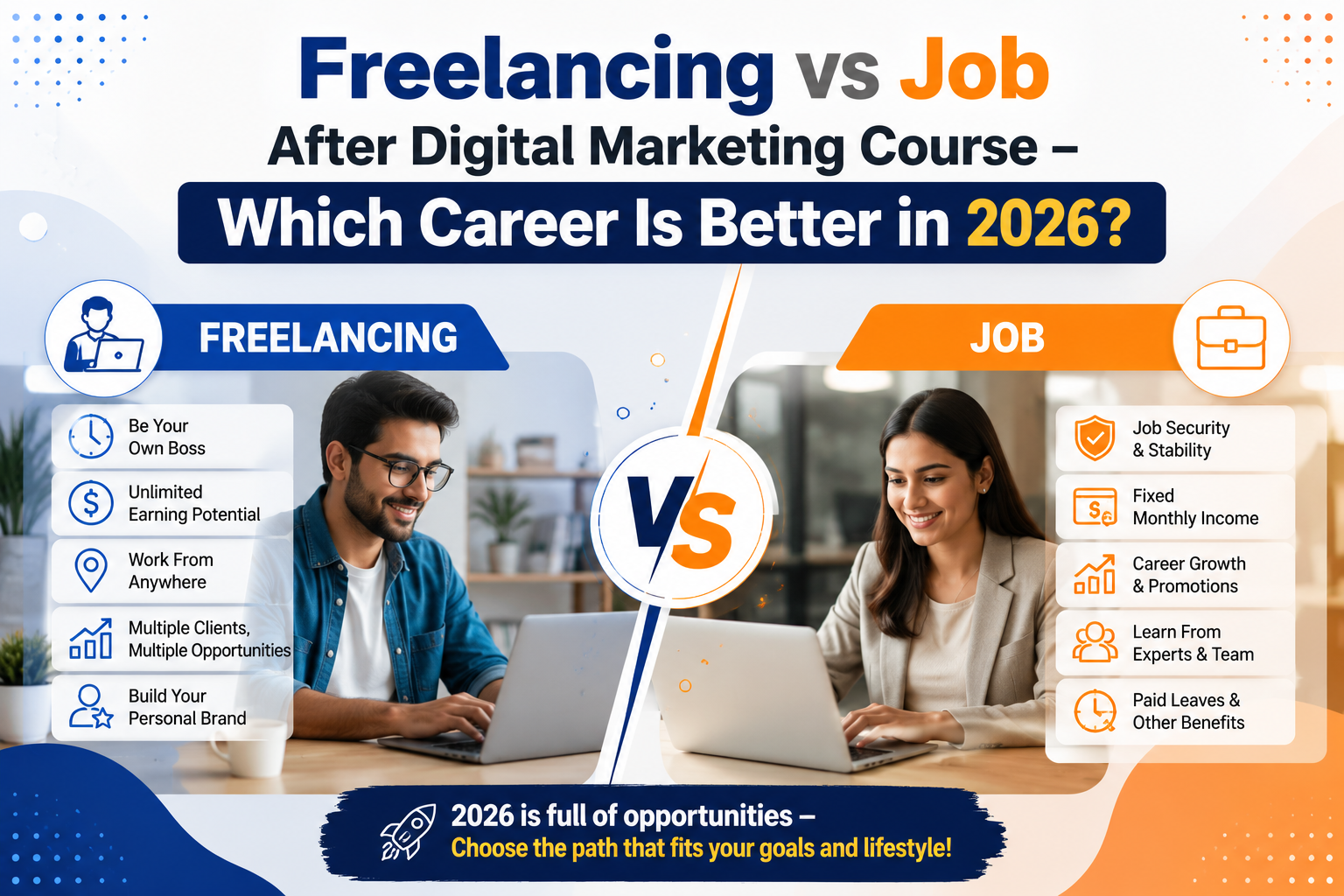
You’ve just completed — or you’re about to complete — a digital marketing course. The skills are in place. The certificate is coming. And now comes the question that nobody prepared you for in the classroom: do you go get a job, or do you start freelancing?
It sounds like a simple choice. It is not. The decision between freelancing and a full-time job after a digital marketing course shapes not just your income but your daily routine, your growth trajectory, your stress levels, and how quickly you build real-world experience. In 2026, with the digital marketing industry evolving faster than ever, this decision carries more weight than it did even two or three years ago.
At Digital Pundit, we have guided hundreds of students through exactly this crossroad — fresh graduates, career-switchers, and entrepreneurs alike. This guide gives you an honest, detailed breakdown of both paths: the income reality, the growth ceiling, the daily experience, and the specific situations where each path makes more sense than the other.
Why This Decision Is Different in 2026
The digital marketing industry in 2026 looks meaningfully different from what it was five years ago. Three shifts have changed the freelancing vs job calculus for fresh course completers.
AI has changed what employers expect from day one. Companies are no longer hiring digital marketers to handle repetitive, manual tasks — those have been automated. They want people who can think strategically, interpret data, run campaigns with real accountability, and adapt to new channels fast. This raises the bar for entry-level job candidates but also creates more genuine demand for skilled freelancers who can deliver specific, measurable outcomes.
Remote work has normalized freelancing. Companies that once insisted on full-time, in-office hires are now comfortable working with skilled freelancers on project or retainer bases — especially for people in cities like Ahmedabad who can now serve clients in Mumbai, Delhi, Bangalore, and globally without relocating.
The gig economy has matured. Freelancing is no longer a fallback for people who couldn’t find jobs. In 2026, it is a deliberate, structured career path that some of the most skilled digital marketers choose intentionally over high-paying corporate roles.
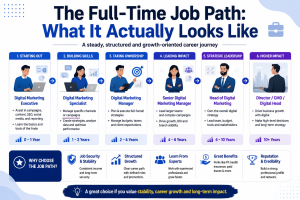
The Full-Time Job Path: What It Actually Looks Like
The Income Reality
Entry-level digital marketing roles in India in 2026 typically start at ₹15,000 to ₹25,000 per month at small and mid-size companies, with larger agencies and corporates offering ₹25,000 to ₹40,000 for fresh graduates with demonstrated skills. The income is predictable — it comes every month, does not depend on finding clients, and makes financial planning straightforward.
What You Actually Gain in a Job
The most underrated benefit of starting your career in a job is the structured learning environment. You work alongside people who have already made the mistakes you would otherwise make on your own. You get feedback on campaigns, see how senior marketers think through strategy, and learn how to handle clients and justify decisions with data — skills no course teaches as effectively as a live job.
Jobs also provide access to professional networks, expensive industry tools, performance reviews that sharpen self-awareness, and LinkedIn credibility that makes future opportunities easier to land.
The Limitations You Need to Know
Jobs have ceilings. Salary increments in digital marketing roles in India average 10 to 20 percent annually for strong performers — respectable, but not the income acceleration that freelancing can offer. Promotions depend on organizational hierarchy, not just individual performance. You may also be assigned clients or industries that do not interest you — a reasonable trade-off for some, a slow-burning frustration for others.
The Freelancing Path: What It Actually Looks Like
The Income Reality
A beginner freelancer in India in 2026 realistically earns ₹10,000 to ₹30,000 in their first few months while building a client base. That same person, with 12 to 18 months of experience and a strong portfolio, can be earning ₹60,000 to ₹1,50,000 or more per month. Senior freelance digital marketing consultants working with international clients frequently earn several lakhs per month. The ceiling is genuinely high — but the floor in the early months can be uncomfortably low.
What You Actually Gain in Freelancing
Freelancing builds a broader skill set than employment. When you freelance, you are the account manager, the strategist, the analyst, and the salesperson, all in one. You learn how to pitch and win clients, how to price your services, and how to deliver results under pressure without a team to catch your mistakes. This forces growth in ways that a structured job environment sometimes delays.
Freelancing also accelerates portfolio building. Because you work across multiple clients and industries simultaneously, your portfolio diversifies faster. A freelancer who has managed SEO campaigns for a fashion brand, run Facebook Ads for a real estate developer, and handled content marketing for a SaaS startup in their first year has a more compelling portfolio than an employee who spent the same year in one company’s marketing department.
The Limitations You Need to Know
The first six months of freelancing after a digital marketing course are genuinely hard. Finding clients takes time. Building trust without a track record is a real challenge. Income is inconsistent. And because there are no colleagues or managers, there is no one to course-correct you when you are heading in the wrong direction.
Freelancing also means no employment benefits — no PF, no gratuity, no employer-provided health insurance, no paid leave. A freelancer earning ₹60,000 per month is not equivalent to a salaried employee earning ₹60,000 — the freelancer is also covering their own tools, taxes, insurance, and gaps between projects.
Head-to-Head Comparison
| Factor | Full-Time Job | Freelancing |
| Starting Income | ₹15,000–₹40,000/month (stable) | ₹10,000–₹30,000/month (variable) |
| Income Growth | 10–20% annual increments | Unlimited — scales with clients & skills |
| Income Stability | High — fixed monthly salary | Low early, improves with experience |
| Learning Speed | Structured, guided, deep in one area | Broad, self-driven, rapid across areas |
| Skill Development | Strong in specialization | Strong across business + marketing |
| Work Flexibility | Low — fixed hours, assigned clients | High — choose clients, hours, projects |
| Career Ceiling | Hierarchy-dependent | No ceiling — limited only by skills |
| Benefits | PF, leave, insurance (employer-provided) | Self-arranged — no automatic benefits |
| Portfolio Building | Slower — one company context | Faster — multiple clients & industries |
| Networking | Deep within one organization | Broad across industries and clients |
| Tools Access | Employer provides all tools | Self-funded — a real cost to factor in |
| Stress Profile | Organizational — hierarchy, deadlines | Entrepreneurial — client acquisition |
| Best For | Structure seekers, early learners | Self-starters, high-growth ambition |
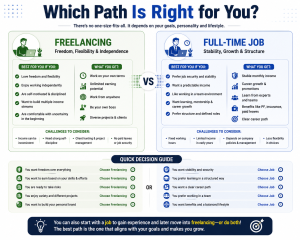
Which Path Is Right for You?
Choose a Full-Time Job if:
- You completed your digital marketing course recently and have limited hands-on campaign experience
- You need financial stability — fixed monthly income to cover rent, loans, or family obligations
- You learn best with structure: feedback from managers, colleagues to collaborate with, and a defined role
- You want to specialize deeply in one area — paid media, SEO, content, analytics — before branching out
- You want to build professional credibility through recognizable employers on your CV
- You are not yet comfortable with client acquisition, sales conversations, or running your own service
Choose Freelancing if:
- You already have some practical experience — from internships, live projects during your course, or your own brand
- You have financial cushion to weather the first 3 to 6 months of building a client base
- You are highly self-motivated and can hold yourself accountable without external structure
- You want income growth that is not capped by organizational hierarchy
- You have a specific niche — local SEO, Google Ads, social media management — that clients will pay for immediately
- You are targeting international clients or want geographic flexibility in your career
The Smartest Path Most People Overlook: Job First, Then Freelance
The binary framing of ‘job vs freelancing’ misses what many successful digital marketing professionals actually do: start with a job, build real skills and portfolio depth in a structured environment, and then transition to freelancing from a significantly stronger position. A person who completes a digital marketing course, works 18 months at an agency, and then goes freelance has results to show, clients who may follow them, and confidence that comes from having delivered under real-world pressure.
How to Maximize Your Start — Whichever Path You Choose
If You Are Starting With a Job
- Do not just execute tasks — ask why. Understand the strategy behind every campaign, not just the mechanics.
- Keep a running portfolio from day one. Document campaigns, results, and learnings. This portfolio belongs to you, not your employer.
- Build your personal brand on LinkedIn alongside your job — it becomes your freelancing pipeline later.
- Take on extra projects when possible to broaden your experience beyond your specific role.
If You Are Starting With Freelancing
- Niche down immediately. ‘I run Google Ads for D2C fashion brands’ wins clients faster than ‘I do digital marketing.’
- Price for sustainability, not desperation. Underpricing attracts low-quality clients and sets a ceiling on your income.
- Build your portfolio before your first client meeting — spec work and personal projects count as evidence.
- Treat client communication as seriously as the work itself. Reliability and consistency often matter more than technical brilliance.
The Digital Marketing Career Landscape in Ahmedabad in 2026
Ahmedabad’s diverse, growing economy — textiles, manufacturing, real estate, retail, and a fast-growing startup scene — presents strong local demand for both employment and freelancing. Agencies are actively hiring trained digital marketers. Local businesses, particularly small and medium enterprises, are increasingly open to hiring freelancers for specific, outcome-based work rather than full-time employees.
Understanding this local demand is one reason the Digital Marketing Course in Ahmedabad at Digital Pundit is designed around what local businesses actually hire for — not a generic curriculum that treats all markets the same. Whether you exit into employment or freelancing, understanding the Ahmedabad market specifically gives you a competitive edge over candidates who trained with generic, national-scale courses.
Frequently Asked Questions
Can I do both — freelance while working a job?
Many digital marketers do exactly this. Freelancing on the side while employed lets you build clients gradually, test your pricing, and develop a portfolio — all without financial pressure. The main constraints are time, energy, and potential employer conflict-of-interest clauses. Done carefully with clear boundaries, side freelancing is one of the best ways to transition into full-time freelancing without income risk.
How long does it take to earn well as a freelancer?
Most freelancers who are consistent, well-niched, and active in outreach reach stable, comfortable income within 12 to 18 months. The first 3 to 6 months are typically the hardest — low income, high uncertainty, steep learning curve in client management. The people who push through that phase consistently report that the income inflection point comes faster than expected once the early groundwork is in place.
Does the quality of my digital marketing course matter for freelancing?
More than it does for employment. Employers can assess your capability through interviews and probation periods. Freelance clients often have no mechanism to evaluate your skills beyond your portfolio and the course credentials you cite. A course from a recognized, practically focused institute — one that trains you on real tools and real campaigns — carries more credibility when you approach potential clients than an unknown online certificate.
Should I specialize or stay a generalist?
For freelancing, specialization almost always wins over generalism in the early stage. A specialist commands higher rates, attracts more targeted clients, and builds a reputation faster than someone who offers every service under the digital marketing umbrella. For employment, generalism can be an advantage in smaller companies — but even there, having one clear area of depth alongside broad awareness is stronger than being equally average at everything.
Final Verdict
Freelancing and full-time employment are not competitors — they are different chapters in what is often the same career story. The question is not which one is objectively better. The question is which one fits where you are right now: your experience level, your financial situation, your risk tolerance, and your long-term goals.
If you are fresh out of a digital marketing course with limited real-world experience, a job gives you the structured environment to build skills that make freelancing far more viable later. If you already have experience, a clear niche, and financial resilience for the first few unpredictable months, freelancing offers an income ceiling and professional freedom that employment rarely matches.
If you want a deeper look at how short-form video fits into a complete digital marketing career toolkit — including how platforms like Instagram Reels and YouTube Shorts are shaping content marketing in 2026 — read our detailed breakdown: Instagram Reels vs YouTube Shorts: Which Drives More Views, Followers & Revenue in 2026?
And if you are ready to build the foundational skills that make both the job path and the freelancing path viable, visit Digital Pundit to explore our courses and resources. The right course does not just give you a certificate — it gives you the confidence to choose your path and execute on it from day one.