


Every local business owner asks the same question at some point: “Why is my competitor showing up above me on Google Maps, even though I know my service is better?” It’s one of the most frustrating experiences in local marketing, doing genuinely good work, yet losing the customer before you ever get the chance to prove it, simply because someone else’s pin sits higher on the map.
The honest answer is that ranking #1 on Google Maps in 2026 isn’t about being the best business in your category. It’s about being the business Google trusts most to be relevant, close, and reliably good, based on signals it can actually measure. The businesses sitting in positions one, two, and three of the local pack aren’t necessarily superior at their craft. They’re superior at giving Google clear, consistent, and continuously refreshed proof that they deserve to be there.
This guide breaks down exactly what it takes to move into that top spot, based on the system Digital Pundit uses when managing Google Business Profiles for clients across Ahmedabad, from service businesses and manufacturers to wellness brands and e-commerce companies. We’ll cover the ranking mechanics, the 11 specific strategies that move the needle, the mistakes that quietly cap your visibility, and what’s changing as AI search reshapes how people find local businesses.
Why “Ranking #1” Is Harder, and More Valuable, in 2026
A few years back, showing up anywhere in the local three-pack was enough to generate a steady trickle of calls. That’s no longer true. Click-through data across nearly every local category shows a steep drop-off after the first result, the business in position one typically captures a disproportionate share of calls, direction requests, and website visits compared to positions two and three, and an even larger gap compared to anything below the fold.
This gap has widened further in 2026 because search behavior itself has changed. People searching on mobile, through voice assistants, or through AI tools like Gemini and ChatGPT are often given a single recommended answer rather than a scrollable list. When an AI system summarizes “the best digital marketing agency near CG Road,” it’s frequently pulling from the same trust signals that determine your #1 Maps ranking, which means the businesses winning at the top of Maps are increasingly the same businesses winning inside AI-generated recommendations too.
In other words, the #1 spot isn’t just marginally better than #3 anymore. It’s becoming the default answer across nearly every way people now discover local businesses.
The Three Ranking Levers Google Actually Pulls
Before diving into tactics, it’s worth understanding the mechanics Google uses to decide who sits at the top. There are exactly three: Relevance, Distance, and Prominence. Every strategy in this guide feeds into one or more of these three levers, nothing you do matters unless it moves one of them.
Relevance: Does Your Profile Actually Match the Search?
Relevance is Google’s confidence that your business genuinely offers what someone is searching for. This is built from your category selection, your services list, your business description, your website content, and even the language used in your reviews.
A subtle but important point: relevance isn’t just about broadly matching a category; it’s about matching specific intent. A search for “SEO agency for e-commerce brands” is a different intent signal than “SEO agency Ahmedabad,” even though both mention SEO. The businesses that rank #1 for the more specific, higher-intent search are usually the ones whose reviews, case studies, and service descriptions explicitly speak to e-commerce work, not just SEO in general.
Distance: How Close Are You to the Person Searching?
Distance is the most rigid of the three factors because it’s based on physical geography, but it’s not entirely fixed. Google evaluates distance relative to your registered address and your defined service areas. A business physically closer to the searcher often has a natural advantage, but a well-optimized business slightly further away can still outrank a poorly optimized one that’s closer, because relevance and prominence can offset a modest distance disadvantage.
For businesses that serve an entire city rather than expecting walk-ins, building genuine local relevance across multiple neighborhoods, through location-specific website content, geographically diverse reviews, and locally relevant case studies, effectively widens the radius in which you can compete for the top spot.
Prominence: Would Google Be Embarrassed to Recommend You?
Prominence is best understood through a simple mental test: if Google put your business at the very top of a search result, would that decision hold up? Would the reviews back it up? Would the photos look credible? Would the profile look active and cared for, or abandoned?
Prominence is built through review volume and quality, backlinks, media mentions, consistent citations, and direct brand searches for your business name. It’s the slowest of the three levers to build, but it’s also the hardest for competitors to quickly copy, which is exactly why it matters so much for holding the #1 position long-term, not just reaching it briefly.
Why Most Businesses Plateau Just Below #1
There’s a specific, predictable pattern to how local businesses approach their Google Business Profile, and understanding it explains why so many stay stuck in position two, three, or four despite genuinely trying to improve.
Most businesses start with real enthusiasm. They fill out their profile, ask a batch of customers for reviews, upload a set of photos, and post a handful of updates over the first few weeks. This initial burst almost always produces some visible improvement, a jump in impressions, a few more calls, maybe a position or two of movement in the local pack. And that’s precisely where the problem begins: the visible improvement feels like “enough,” so the effort quietly tapers off.
Meanwhile, the business currently sitting at #1 isn’t standing still. They’re still collecting reviews every week. They’re still posting. They’re still adding photos. The gap that the initial burst of effort closed starts reopening, slowly and almost invisibly, because ranking is inherently relative, it’s not about reaching some fixed bar, it’s about staying ahead of whoever else is actively working on the same thing.
This is the single biggest mindset shift required to actually reach and hold #1: treating GBP optimization as a permanent, ongoing operational habit rather than a project with a defined end date. Every strategy that follows in this guide only works if it’s sustained well past the point where the profile first starts “looking good.”
The 11 GBP Optimization Strategies That Actually Move You to #1
Strategy #1: Treat Profile Completeness as a Non-Negotiable Baseline, Not a Bonus
Businesses ranking in position one almost never have gaps in their profile. Every field, business name, categories, address, service areas, phone number, website, hours, holiday hours, description, services, products, attributes, and photos, is filled out with real, specific information.
Think of an incomplete profile not as “missing an opportunity” but as actively disqualifying yourself from top rankings before the competition even begins. If a competitor has listed 12 specific services with detailed descriptions and you’ve listed two generic ones, Google has 6x more relevant text to match you against, and so does the customer scanning both profiles side by side.
A practical starting point: Open your GBP dashboard and go field by field. For every section that says “add” instead of showing real content, that’s a specific, fixable gap between you and the #1 spot. Most businesses find at least five to ten incomplete fields the first time they audit their own profile honestly.
Strategy #2: Get Category Selection Exactly Right, Then Leave It Alone
Category selection has an outsized effect on ranking relative to how little time most businesses spend on it. The primary category should represent the single activity that best matches your highest-value searches, not the broadest category available, and not the one that sounds most impressive.
A useful exercise: open an incognito browser, search your top three target keywords on Google Maps, and note the categories used by whichever businesses currently hold positions one through three. This tells you, directly from Google’s own behavior, which categories it associates with top rankings for that specific search, far more reliable than guessing.
Once you’ve set an accurate primary category and a small number of genuinely relevant secondary categories, resist the urge to keep changing them. Frequent category swapping can create instability in how Google understands your business, temporarily suppressing rankings while it recalibrates.
Strategy #3: Build a Review Engine, Not Just a Review Habit
Most businesses “ask for reviews” occasionally, usually when they remember to. Businesses that reach #1 build systems, a repeatable process that captures reviews consistently, month after month, without relying on someone remembering to ask.
A simple, ethical review engine looks like this: identify the specific moment in your customer journey when satisfaction peaks (project delivery, successful campaign result, completed service), automate or standardize a review request at that exact moment via WhatsApp or email, and track your monthly review count as a KPI the same way you’d track leads or revenue.
Quality still outranks quantity. A review that mentions a specific service, a specific outcome, and reads like a real person wrote it in their own words carries more weight, both with Google’s systems and with the human reading it, than a generic “great service, highly recommend.”
Never buy or incentivize reviews. Google’s detection systems specifically look for unnatural patterns, review bursts, similar phrasing across multiple reviews, or accounts with no other review history, and the penalty for getting caught (suspension, review removal, ranking collapse) is far more costly than the short-term boost.
Strategy #4: Make Review Responses Part of Your Ranking Strategy, Not an Afterthought
Every review reply is public content that Google can read and future customers will read. Businesses at the top of Maps rankings reply to nearly 100% of their reviews, usually within a day or two.
A specific, thoughtful reply to a positive review, one that names the actual service the customer used, reinforces relevance signals in exactly the same way a well-written service description does. A calm, professional reply to a negative review does something equally valuable: it proves to every future reader that your business handles problems like a business worth trusting, which often matters more to a skeptical searcher than the negative review itself.
Set a standing rule: no review goes unanswered for more than 48 hours. This single habit, maintained consistently, does more for perceived trustworthiness than almost any other single action on this list.
Strategy #5: Post on GBP Like It’s a Live Channel, Not a Static Listing
Google Business Profile posts are one of the clearest ways to signal ongoing activity, and yet the vast majority of local businesses either never use them or abandon them after the first month.
Businesses competing seriously for the #1 spot treat this like any other content channel, planned in advance, published on a fixed schedule (weekly at minimum, two to three times weekly for competitive categories), and mixed across formats: results and case studies, service or product spotlights, client stories, educational tips, and timely offers.
For Digital Pundit specifically, a strong weekly rhythm might include a Monday case-study result, a Wednesday educational tip about SEO or Google Ads, and a Friday client spotlight or testimonial, giving Google fresh, varied signals every few days rather than one post a month.
Strategy #6: Use Photos and Video to Win the Split-Second Trust Decision
When someone compares two nearly identical local pack results, the deciding factor is often visual, which profile simply looks more real, more active, and more professional in the two or three seconds a searcher spends scanning it.
The #1 position tends to belong to profiles with a genuinely diverse, regularly refreshed photo gallery: real team photos, real workspace or facility shots, client interactions, event coverage, and short videos, not a handful of stock images uploaded once at setup and never touched again.
Google’s own data consistently shows that profiles with recently added photos receive meaningfully more views than those with stale galleries, which suggests photo freshness itself functions as a soft activity signal, separate from the visual trust effect on human viewers.
Strategy #7: Let Your Website Do the Heavy Lifting Your GBP Can’t
Your Google Business Profile has limited space to prove your expertise. Your website doesn’t. The businesses that consistently hold the #1 spot use their website to go deep, service pages with real detail, location pages built around genuine local relevance, case studies, FAQs, and blog content that demonstrates authority on the topics closest to their business.
Schema markup (LocalBusiness, Service, FAQPage, Review) helps Google and AI systems parse this information with precision rather than guesswork, which matters increasingly as AI Overviews and conversational search tools rely on structured data to generate their summaries.
Internal linking between related blog posts and service pages spreads topical authority across your site, helping Google recognize you as a genuine expert on a subject rather than a business that happens to mention it once. If you’re still getting familiar with how SEO, AEO, and GEO fit together in 2026, our complete FAQ guide to SEO, AEO, and GEO for beginners is a useful place to start.
Strategy #8: Clean Up Your Citations Before You Build New Ones
Most businesses trying to improve local rankings jump straight to building new citations without first auditing existing ones, which means they’re often reinforcing inconsistent, outdated information across the web without realizing it.
Before adding new directory listings, search your business name across major directories and note any discrepancies in name formatting, address details, or phone numbers. Fix these first. Once your existing citation footprint is clean and consistent, expanding into new, relevant directories reinforces trust rather than adding to the confusion.
Strategy #9: Engineer More Calls, Clicks, and Direction Requests
Engagement is the feedback loop that tells Google your visibility is actually working, and it’s also the metric most directly tied to your goal of reaching #1, since visibility and engagement reinforce each other in both directions.
Specific, actionable ways to increase engagement include: keeping your phone number prominent and clickable, enabling WhatsApp or direct messaging, using GBP posts with clear calls to action rather than vague updates, and ensuring your linked website loads quickly on mobile so clicks don’t bounce immediately.
Businesses that track calls and direction requests as a monthly metric, the same way they’d track leads from a paid campaign, tend to notice and fix engagement problems faster than those who only glance at their star rating occasionally.
Strategy #10: Fill Your Services and Products Sections Like a Menu, Not an Afterthought
Think of your services section the way a restaurant thinks about its menu, every item listed separately, described clearly, and written to help someone decide quickly. Businesses that reach #1 rarely lump their offerings into one or two vague lines.
For an agency, that means listing SEO, Google Ads, social media management, website design, content marketing, and GBP optimization as distinct services, each with a specific description of what’s included and who it’s for. For a manufacturer, wellness brand, or e-commerce business, the same principle applies to product categories, training programs, or flagship products, specificity consistently outperforms vagueness in how Google matches you to searches.
Strategy #11: Build Authority That Exists Outside of Google Itself
The final, and often slowest, lever is local authority, the mentions, backlinks, partnerships, and community presence that exist independently of your Google Business Profile but still feed back into how prominent Google considers your business.
This might mean guest content on relevant local publications, speaking at local business events, partnerships with complementary businesses for cross-referrals, trade association memberships, or press coverage of genuine milestones. Businesses holding the #1 spot in competitive categories almost always have this kind of authority layered underneath their profile, it’s usually the difference-maker once every other competitor has a reasonably complete, active profile.
What Separates #1 from #3 When Everyone Looks “Optimized”
In many competitive categories today, the top four or five results all have reasonably complete profiles, decent review counts, and some level of posting activity. At this stage, small differences start deciding the outcome.
Response time to reviews, replying within hours rather than weeks, is a subtle but real differentiator. Review specificity, reviews that name exact services and outcomes rather than generic praise, carries more relevance weight than raw review count alone. Posting consistency over months, not just an active-looking burst during a recent audit, signals genuine ongoing investment rather than a one-time cleanup. And engagement trendlines, calls and clicks steadily increasing month over month, tell Google your visibility is translating into real usefulness, which is ultimately what determines who gets rewarded with the top spot and who gets stuck just below it.
It’s worth being specific about how these small differences actually show up in practice, because they’re easy to underestimate from the outside. Two competing agencies might both have 80 reviews and post weekly, but if one replies to every review within a day and the other lets replies pile up for two or three weeks at a time, Google’s activity signals treat these very differently, even though both profiles “look” similarly active on the surface to a casual observer.
Similarly, a review that says “Digital Pundit helped us increase our organic traffic through a targeted SEO and content strategy over three months” carries meaningfully more relevance weight than “great agency, would recommend”, even though both are five-star reviews and both count equally toward your total review count. The specificity itself is doing real work, both for Google’s relevance matching and for a human reader trying to decide whether this business actually does what they need.
Common Reasons Businesses Get Stuck at Position 3, 4, or 5
- An inaccurate or overly broad primary category that dilutes relevance for the specific, high-value searches that matter most.
- A review count that has plateaued often because review requests stopped once the profile “looked good enough.”
- Photos that haven’t been updated in over a year, making the profile look inactive even when the business itself is thriving.
- GBP posts that started strong and quietly stopped after the first few weeks of enthusiasm.
- A weak or thin website that doesn’t back up the claims made on the Google Business Profile.
- Inconsistent NAP details scattered across old directory listings that were never cleaned up.
- No local authority signals beyond the profile itself no mentions, no backlinks, no press, nothing reinforcing prominence from outside sources.
Notice that none of these are exotic or hard to understand they’re simply areas where consistent effort quietly stopped, usually right around the point where the business “looked fine” rather than continuing to actively compete for the top spot.
Why Mobile Behavior Makes the #1 Spot Even More Valuable
The overwhelming majority of local searches now happen on a phone, often in the middle of another activity, walking somewhere, driving, or actively comparing options while already partway through a decision. This context matters more than it might seem, because it shapes exactly how much attention a searcher gives to results below the very top of the local pack.
On a small mobile screen, only the top two or three local pack results are typically visible without scrolling, and the visual difference between position one and position three in terms of thumbnail photo, star rating, and review count is compressed into a glance lasting a second or two. In this environment, the #1 result doesn’t just get more clicks; it often gets almost the entire benefit of the doubt in the split-second the searcher spends deciding, before they’ve meaningfully considered any alternative at all.
This mobile-first reality is part of why the gap between #1 and #3 has widened rather than narrowed in recent years, and it’s a big part of why the sustained, ongoing effort described throughout this guide continues to pay off the businesses at the very top are capturing a share of attention that’s disproportionate to how “close” the actual competition looks on paper. Businesses that understand this dynamic tend to prioritize the top spot far more aggressively than those still thinking in terms of a traditional, ten-blue-links search results page, where the difference between positions felt far less dramatic.
How AI Search Is Redefining What “#1” Even Means
Historically, ranking #1 meant sitting at the top of the local three-pack on a traditional search results page. In 2026, that’s only part of the picture. AI Overviews, voice assistants, and conversational tools like ChatGPT and Gemini increasingly deliver a single recommended business rather than a ranked list which means there’s effectively a new, higher-stakes version of “#1”: being the one business an AI system chooses to mention by name.
These systems draw heavily on the same underlying signals structured business data, review sentiment, topical authority, and consistency across the web but they weigh clarity and trustworthiness even more heavily than traditional ranking algorithms, because they’re generating a direct answer rather than a scrollable list a user can browse through themselves.
This raises the bar in a specific way: schema markup, FAQ content, and genuinely detailed, well-organized website content matter more than ever, because AI systems rely on structured, unambiguous information to confidently generate a recommendation. A business with a strong Maps ranking but a thin, unstructured website may still lose the AI-recommendation moment to a competitor with slightly weaker Maps visibility but far clearer, more structured digital content.
How to Actually Study Your Competitors Before You Try to Beat Them
Most businesses glance at whoever currently ranks #1, feel briefly discouraged, and move on without extracting anything useful from the comparison. A proper competitor teardown, done once at the start and revisited every few months, is one of the highest-leverage exercises in this entire process.
Start by identifying the three businesses currently ranking above you for your two or three most important search terms. For each one, note their exact primary category, roughly how many reviews they have and how recently the most recent ones were posted, whether they’re actively using GBP posts and how often, the general quality and recency of their photo gallery, and whether they reply to reviews consistently.
This isn’t about copying a competitor directly it’s about identifying the specific gap between where you are and where they are on each individual factor. A competitor with 150 reviews to your 40 tells you review velocity is your priority. A competitor posting three times a week to your zero tells you exactly where to start. This kind of specific, factor-by-factor comparison is far more useful than a vague sense that “they’re just doing better,” because it turns an abstract feeling into a concrete, prioritized action list.
Revisit this teardown every three to four months. Competitors who were ahead of you six months ago may have slowed down, and new competitors may have entered the picture the local pack is never static, and neither should your competitive awareness be. Businesses that build this quarterly check into their routine tend to catch shifting competitive dynamics months before they’d otherwise notice through ranking movement alone.
A Month-by-Month Path Toward the #1 Spot
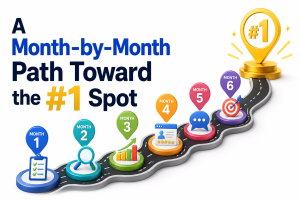
Month 1: Full profile audit and completion. Category correction if needed. Citation cleanup begins. First systematic review requests go out. Weekly posting starts.
Month 2: Review volume begins climbing steadily. Website service and location pages get rewritten with genuine depth. Photo and video library expands with real, current content.
Month 3: Engagement metrics (calls, clicks, direction requests) start trending upward as the profile’s visibility improves. Early local authority-building guest content, partnerships begins.
Months 4 to 6: Rankings typically show meaningful, sustained movement in competitive categories. Authority-building efforts from month 3 start paying off. Review response time and specificity become a genuine differentiator against competitors who’ve plateaued.
Month 6 onward: For businesses that have stayed consistent, the #1 or top-3 position becomes increasingly stable, and the ongoing work shifts from aggressive optimization to steady maintenance keeping the review engine running, the posting calendar active, and the content fresh enough that competitors can’t easily close the gap.
Industry-by-Industry: What #1 Looks Like Depending on What You Sell
The mechanics of ranking #1 stay the same across industries, but the specific content that fills each strategy looks different depending on what you actually sell. Digital Pundit manages profiles across several very different kinds of businesses, and the pattern below holds consistently.
Service Agencies (Marketing, Consulting, Design)
For an agency, the #1 spot is usually won through depth of proof detailed case studies with real numbers, a services list broken into individual, specific offerings rather than one vague line, and reviews that name exact deliverables and outcomes. Because agency work is intangible, photos of the actual team, workspace, and client interactions matter more than most agency owners assume, since they’re often the only visual proof a prospect gets before making contact.
Manufacturers and B2B Suppliers
For manufacturing and industrial businesses, ranking #1 often depends heavily on category accuracy and product-level detail, since B2B searchers tend to search with far more specific intent a particular material, process, or capability rather than a broad category. Certifications, factory photos, and consistent citations across industry-specific directories carry disproportionate weight here, because B2B buyers are actively looking for credibility signals before ever picking up the phone.
Wellness, Training, and Education Businesses
For yoga schools, training institutes, and wellness brands, reviews and real photos do most of the heavy lifting, because these are high-trust, often high-commitment purchases. A prospective student researching a teacher training program or retreat is looking for proof that real people had a real, positive experience generic stock photography and vague service descriptions are particularly damaging in this category compared to others.
E-commerce and Retail Businesses with a Physical Presence
For retail and e-commerce businesses with a local storefront or pickup location, direction requests and in-stock product visibility matter more heavily, and GBP posts showcasing new arrivals or seasonal offers tend to drive engagement more directly than in service categories. Product-level detail in the products section, paired with genuine customer photos, tends to be the differentiator between a #1 and a #3 ranking in this category.
Tools and Habits That Make This System Sustainable
Knowing what to do is only half the challenge the businesses that actually reach and hold the #1 spot build habits and lightweight systems that make consistency easy rather than relying on willpower or memory.
A content calendar for GBP posts, even a simple spreadsheet planned a month in advance, removes the friction of “what do I post today” that causes most businesses to quietly abandon posting after a few weeks.
A standing review request trigger tied to a specific moment in your customer journey a project handover, a delivery confirmation, a completed session removes the dependency on someone remembering to ask manually every time.
A monthly GBP Insights check, scheduled the same way you’d schedule a monthly financial review, catches problems early: a sudden drop in views, a stalled review count, or declining engagement, all of which are far cheaper to fix within weeks than after months of unnoticed decline.
A shared photo folder that team members can drop real, current photos into throughout the month team moments, project shots, client interactions make it far easier to keep the profile’s visual content fresh without a dedicated photography effort every single time.
What Happens After You Reach #1
Reaching the top spot is not the finish line it’s the point where competitors start actively trying to catch up to you, often by copying exactly the strategies that got you there. Maintaining the #1 position requires the same discipline that earned it, sometimes even more, because complacency at the top is exactly the opening a determined competitor needs.
Businesses that hold their #1 ranking long-term typically keep their review engine running at the same pace even after the “urgent” push to reach the top spot has passed, continue posting on the same weekly rhythm rather than scaling back, and keep adding fresh photos and updated service information as their business genuinely evolves rather than letting the profile freeze at the state it was in when they first reached the top.
The businesses that lose their #1 spot after reaching it almost always do so for the same reason they gained it in the first place, they treated the effort as a one-time project rather than an ongoing discipline, and a more consistent competitor eventually caught up. Holding the top spot, in the end, tends to reward exactly the same behavior that earned it.
Frequently Asked Questions
1. Is it possible to rank #1 without spending money on ads?
Yes, Google Maps organic (non-paid) rankings are entirely separate from Local Services Ads or Google Ads. The strategies in this guide are all organic and don’t require ad spend, though paid campaigns can complement organic visibility for businesses wanting faster initial traffic.
2. How many reviews do I need to rank #1?
There’s no fixed number it depends heavily on your category and city. What matters more than a specific count is consistent, ongoing growth alongside genuine review quality and response rate, rather than hitting an arbitrary target and stopping.
3. Can a newer business outrank an older, more established competitor?
Yes, particularly in categories where the established competitor has neglected their profile. A newer business with a complete profile, active posting, and a strong review engine can often outrank an older business coasting on reputation alone.
4. Does responding to negative reviews actually help rankings?
It helps trust and conversion more directly than it helps raw ranking algorithms, but since engagement and prominence both factor into ranking, a profile that looks actively managed including thoughtful responses to criticism tends to perform better overall.
5. How often should I really be posting on GBP?
Weekly at an absolute minimum. Businesses actively competing for the top spot in a competitive category typically post two to three times per week.
6. What’s the very first thing I should do if I’m starting from scratch today?
Open your profile and read it the way a stranger would no prior knowledge of your business. Note every field that’s vague, missing, or outdated. That honest audit, done in the next fifteen minutes, will tell you more about your actual starting point than any amount of reading about strategy, and it’s the single most useful first step before anything else in this guide.
7. Seasonal and Category-Specific Timing Considerations
Not every category experiences local search demand evenly throughout the year, and understanding your own seasonal pattern helps you time your heaviest optimization push for maximum impact rather than spreading effort evenly across months that don’t matter equally.
For businesses with a clear seasonal peak wedding-related services ahead of wedding season, tax and financial consultants ahead of filing deadlines, gifting and retail businesses ahead of festival periods, the review and content push described in this guide should ideally be well underway at least two to three months before that peak begins. Rankings don’t shift instantly; the review velocity and posting consistency built up in the preceding months are what position a business to actually capture the surge in search volume when it arrives, rather than scrambling to optimize once demand has already peaked.
For businesses with steadier, year-round demand, most B2B services, healthcare, and everyday local services, the advantage lies less in timing a seasonal push and more in simply maintaining unbroken consistency, since there’s no natural peak competitors are also rushing to capture. In these categories, the businesses that win #1 are usually the ones who never really stopped, rather than the ones who timed a clever seasonal sprint.
Metrics That Actually Predict a #1 Ranking
Most businesses watch only their star rating, which turns out to be one of the weaker predictors of ranking movement. A handful of other metrics, tracked consistently, tend to correlate far more closely with actual position changes on Google Maps.
Review velocity the rate at which new reviews arrive, not just the total count tends to matter more than the raw number. A profile steadily gaining three to five reviews a month looks meaningfully more active to Google than one that gained forty reviews two years ago and none since.
Discovery-search share the proportion of your profile views coming from category or keyword searches rather than people searching your business name directly reflects genuine new-customer visibility rather than existing brand awareness. A rising discovery-search share is one of the clearest early signs that your ranking is genuinely improving, often visible weeks before the actual Maps position shifts.
Photo and post recency how many days have passed since your last upload or post is a simple, easy-to-track number that correlates strongly with how “alive” a profile appears, both to Google’s systems and to human searchers scanning results quickly.
Response rate and response time on reviews the percentage of reviews you’ve replied to, and how quickly is fully within your control and costs nothing beyond a few minutes a week, which makes it one of the highest-leverage metrics on this entire list relative to the effort required.
Tracking these four numbers monthly, alongside the standard GBP Insights data, gives a far more accurate read on whether your #1 push is actually working than simply refreshing your Maps search every few days and hoping for movement.
Myths About Ranking #1 on Google Maps
A number of persistent myths cause businesses to waste effort in the wrong places or, worse, take risky actions that can actively damage their ranking. It’s worth addressing the most common ones directly.
Myth: “I just need more reviews than my competitor.” Review count matters, but quality, recency, and response rate all factor in alongside volume. A business with fewer but more recent, more detailed, consistently-responded-to reviews regularly outranks a competitor with a larger but stagnant review count.
Myth: “Keyword stuffing my business name will help me rank higher.” This directly violates Google’s guidelines and carries real suspension risk. Any short-term visibility gain is rarely worth the risk of losing the listing entirely, sometimes for weeks while an appeal is processed.
Myth: “Once I reach #1, I can ease off.” As covered earlier in this guide, the #1 position is actively contested by every competitor working to take it. Easing off is the single most common reason businesses lose a hard-won top ranking within a few months.
Myth: “Paying for citations or backlinks in bulk will speed things up.” Low-quality, irrelevant, or clearly purchased citations and backlinks tend to add noise rather than genuine authority, and in some cases can trigger the exact kind of manipulation detection that hurts rather than helps a profile.
Myth: “My website doesn’t matter much if my GBP is strong.” Google increasingly cross-references your website to validate the claims on your profile, and AI search tools rely even more heavily on website content and structure. A weak website caps how far a strong GBP alone can carry you.
The 90-Day #1 Ranking Action Plan
Reading about strategy is useful, but most businesses need a concrete, week-by-week starting point. Below is the exact sequence Digital Pundit follows when taking on a new GBP client with the specific goal of reaching the top of the local pack within a competitive category.
| Timeframe | Focus Area | Specific Actions |
| Week 1 | Audit | Full profile audit, competitor category and keyword analysis, citation consistency check |
| Week 2 | Foundation | Complete every profile field, correct category if needed, rewrite business description, fill services/products in detail |
| Weeks 3-4 | Visual refresh | Upload real, current photos across all categories; add at least one short video; remove outdated or stock imagery |
| Weeks 3-4 | Review engine setup | Identify the ideal review-request moment in the customer journey; set up a WhatsApp/email review request template; begin outreach to recent happy customers |
| Weeks 5-8 | Posting rhythm | Launch a weekly (or twice-weekly) GBP posting calendar mixing case studies, tips, offers, and client stories |
| Weeks 5-8 | Citation cleanup | Fix inconsistent NAP details across existing directories; remove duplicate listings |
| Weeks 9-12 | Website reinforcement | Rewrite or build out service and location pages with genuine depth; add schema markup; publish supporting blog content |
| Weeks 9-12 | Authority building | Begin outreach for guest content, partnerships, or local press mentions relevant to the business category |
| Ongoing from Week 12 | Monitoring | Monthly GBP Insights review; track review velocity, discovery-search share, and engagement trendlines; adjust posting and outreach based on what’s working |
This sequence isn’t rigid a business with an already-strong review base might skip ahead to website reinforcement sooner, while one with serious citation inconsistencies might need to extend that phase. But the underlying order matters: foundation and completeness come first, because every later strategy performs better once the basic profile is accurate and complete, rather than trying to build authority or drive engagement on top of a shaky, incomplete base.
Additional Questions Business Owners Ask
Should I focus on Google Maps ranking or my website’s organic Google ranking first?
For most local, in-person, or locally-searched service businesses, Google Maps visibility tends to drive more immediate calls and enquiries than traditional organic website ranking, simply because local searches skew heavily toward the map pack. That said, the two reinforce each other a strong website supports GBP ranking, and a strong GBP drives more branded searches that support organic website ranking. Businesses with limited time or budget usually see faster returns focusing on GBP first, then layering in broader website SEO.
What if I operate from multiple locations does each one need to compete separately for #1?
Yes. Each verified location has its own Google Business Profile and competes independently in its own local pack. The same strategies apply to each one individually, though citation consistency and brand-level authority (reviews, mentions, backlinks pointing to the overall brand) can provide some shared benefit across locations.
Can a single bad review permanently damage my chances of reaching #1?
No single review, positive or negative, typically has a lasting effect on ranking by itself. What matters is the overall pattern over time consistent review growth, a healthy average rating, and thoughtful responses. A well-handled negative review, in fact, often strengthens trust rather than damaging it, provided the response is calm and professional.
Is it worth hiring an agency, or can this realistically be done in-house?
It can absolutely be done in-house by a business owner or team member willing to commit consistent time to it nothing in this guide requires specialized tools beyond the free GBP dashboard itself. If you’d rather build this skill within your own team, our SEO course and training institute in Ahmedabad covers exactly this kind of practical, implementation-based local SEO work. The main reason businesses choose to work with an agency like Digital Pundit is consistency at scale: maintaining a weekly posting rhythm, ongoing review outreach, ongoing citation monitoring, and website updates across months or years is where in-house efforts most commonly lose momentum once daily operations take priority.
Calculating Whether the Effort Is Actually Worth It
Business owners often ask, reasonably, whether the sustained effort described throughout this guide actually pays for itself. The honest answer depends on your average customer value, but the underlying math is usually favorable for most local businesses once you account for the compounding nature of organic visibility.
Unlike paid advertising, where visibility disappears the moment spending stops, a strong Google Business Profile continues generating calls and enquiries with minimal ongoing cost once it’s established the main investment becomes time rather than money, largely spent on consistent posting, review outreach, and occasional content updates.
A simple way to think about it: estimate your average customer value, then estimate how many additional calls or enquiries a stronger #1 ranking might realistically generate per month compared to your current position, based on the click-through drop-off discussed earlier in this guide. For most local businesses in competitive categories, even a modest increase in monthly enquiries from organic Maps visibility pays for the time invested many times over within the first year, and the advantage compounds further in subsequent years as review count, authority, and content depth continue building on themselves.
This is ultimately why the #1 position is worth pursuing deliberately rather than hoping it happens passively the cost of consistent effort is fixed and predictable, while the return grows steadily over time in a way that one-off paid campaigns simply can’t replicate on their own.
The #1 Spot Is a System, Not a Trick
There’s no single setting, hack, or shortcut that moves a business to the top of Google Maps. The businesses that get there and stay there are the ones treating their Google Business Profile as a genuine, ongoing marketing channel with the same discipline they’d apply to paid advertising or website development rather than a one-time setup task completed and forgotten.
Every strategy in this guide reinforces the others. A complete profile without reviews looks empty. A strong review count without recent activity looks abandoned. Great photos without a supporting website undersell your credibility the moment someone clicks through. The businesses sitting at position one have simply stopped treating any single piece of this system as optional.
At Digital Pundit, we build and manage exactly this kind of system for clients across Ahmedabad auditing profiles, fixing the gaps that are quietly capping visibility, and running the consistent, month-over-month work that actually moves businesses into the #1 spot and keeps them there. Whether you’re starting from an incomplete, neglected profile or trying to close the final gap between position three and position one, the path forward is the same: complete the basics fully, build genuine trust signals consistently, and never treat the work as finished.