

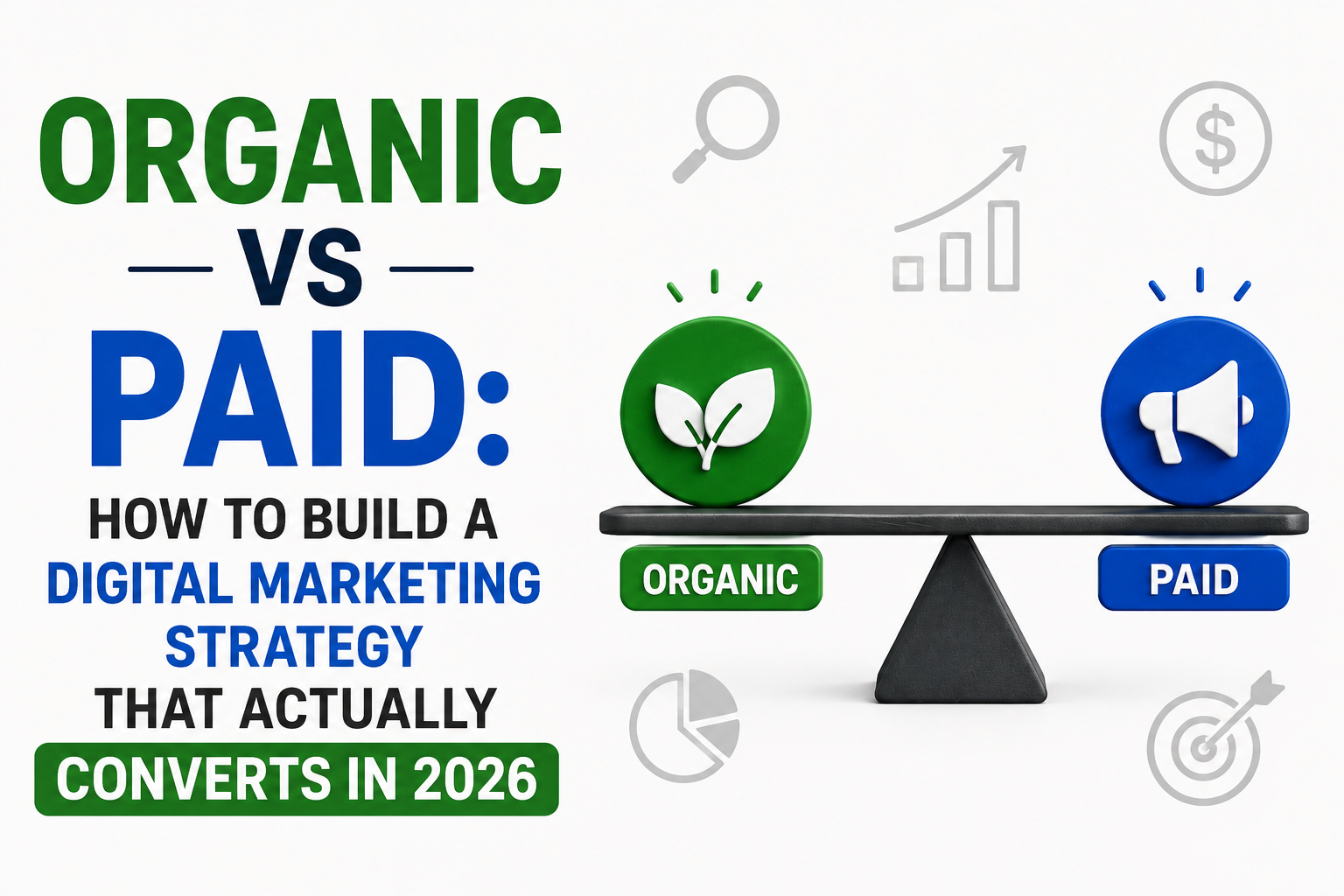
Every business owner eventually asks the same question: should I invest in SEO, or should I just run paid ads? It’s a fair question, and honestly, it’s the wrong one to ask in isolation. The businesses winning in 2026 aren’t choosing one over the other — they’re building a strategy where organic and paid work together, each one covering the other’s weaknesses.
At Digital Pundit, a trusted digital marketing institute in Ahmedabad, we’ve worked with brands that burned through ad budgets chasing instant results, and others that waited a year for SEO to “kick in” while losing market share to faster-moving competitors. Both approaches, used alone, leave money on the table. This guide breaks down exactly how organic and paid marketing differ, when to use each, and how to combine them into a strategy that actually converts — not just clicks. And if you’d rather learn how to build this strategy yourself, this is exactly what we teach in our digital marketing course in Ahmedabad.
What Organic Marketing Really Means
Organic marketing is the traffic and visibility you earn without paying for clicks — primarily through SEO, content marketing, social media, and increasingly, through AI-driven search engines. When someone searches for a solution and lands on your blog post or service page without you paying for that click, that’s organic.
The biggest misconception about organic marketing is that it’s “free.” It’s not. It costs time, content production, technical optimization, and patience. What you’re really paying for is compounding value — a well-optimized blog post can keep generating traffic and leads for years, unlike an ad that stops the moment you stop paying.
Strengths of Organic Marketing
Organic traffic tends to convert better over time because users are actively searching for answers, not being interrupted by an ad. It also builds long-term brand authority — when your website consistently ranks for relevant queries, you’re seen as a credible source rather than just another advertiser. And once a piece of content ranks well, the cost per lead drops dramatically compared to ongoing ad spend.
Limitations of Organic Marketing
The obvious downside is speed. SEO results typically take three to six months to materialize, sometimes longer in competitive industries. It’s also unpredictable — algorithm updates, increased competition, or shifts in how search engines (and now AI answer engines) display results can affect your rankings overnight.
What Paid Marketing Really Means
Paid marketing covers Google Ads, Meta Ads, LinkedIn Ads, and any channel where you’re directly paying for visibility or clicks. The appeal is obvious: you can launch a campaign today and see traffic, leads, or sales within hours.
Strengths of Paid Marketing
Paid campaigns give you immediate, measurable results. You control exactly who sees your ad through precise targeting — location, age, interests, behavior, and even retargeting people who’ve already visited your site. This makes paid ideal for time-sensitive promotions, product launches, or testing which messaging resonates before investing in organic content around it.
Limitations of Paid Marketing
The moment your budget stops, your traffic stops. There’s no compounding value — every month starts from zero. Costs per click are also rising across nearly every industry as competition increases, which means your customer acquisition cost can quietly erode your margins if you’re not tracking it closely.
The Real Question: How Do They Work Together?
Rather than treating organic and paid as competing budgets, the smartest businesses treat them as two arms of the same strategy.
Use paid ads to validate what organic should focus on. Before investing months into an SEO content plan, run a small paid campaign to see which messaging, offers, or audience segments actually convert. This data tells you exactly what to build organic content around — saving you from guessing.
Use organic content to lower your paid acquisition costs. When someone clicks your ad and lands on a page that’s also well-optimized for SEO — fast-loading, clearly structured, answering their actual question — your conversion rate improves and your quality score on platforms like Google Ads goes up, which often lowers your cost per click.
Use paid to dominate while organic is still growing. If you’re launching a new website or entering a competitive market, your organic rankings won’t appear overnight. Paid ads fill that visibility gap while your SEO and content strategy mature in the background.
Use retargeting to capture organic visitors who didn’t convert. Someone reads your blog post, isn’t ready to buy, and leaves. A retargeting ad brings them back when they are ready — this is one of the highest-converting tactics available because you’re targeting people who already showed interest.
Why 2026 Changes the Equation
Search itself is evolving. AI-powered answer engines and generative search experiences are increasingly summarizing information directly in search results, which means traditional organic strategies need to adapt — not disappear. This shift particularly affects local businesses, who now need visibility not just in traditional search results but in AI-generated local recommendations too. If you’re a local business trying to understand how this shift affects your visibility, this guide on Generative Engine Optimization (GEO) for local businesses breaks down exactly what’s changing and how to adapt your strategy.
This is also why digital marketing skills themselves are in higher demand than ever. Businesses need people who understand both the creative and technical sides of organic and paid — not just one or the other.
Building Your 2026 Strategy: A Practical Framework
Start by auditing where your current traffic and leads actually come from. Most businesses are surprised to find they’re over-invested in one channel and under-invested in the other. If 90% of your leads come from paid ads, you’re vulnerable to rising costs and algorithm changes on ad platforms. If 90% come from organic, you’re likely leaving fast, scalable growth opportunities on the table.
Next, set different goals for each channel. Paid should be measured on immediate ROI — cost per lead, cost per acquisition, return on ad spend. Organic should be measured on a longer timeline — ranking improvements, organic traffic growth, and content engagement over quarters, not days.
Finally, make sure your landing pages serve both masters. A page built for SEO should still be structured to convert paid traffic, and a page built for a paid campaign should still follow basic on-page SEO practices. There’s no reason to build two separate pages when one well-built page can serve both purposes. This is precisely the kind of integrated, practical thinking we focus on at our digital marketing institute in Ahmedabad — strategy that works in the real world, not just in theory.
Skip the Guesswork — Learn the Strategy Behind It
If this breakdown made you realize you don’t just want to outsource your marketing but actually understand how to build and run these strategies yourself, that’s exactly what a structured course can offer. A good digital marketing course in Ahmedabad doesn’t just teach you Google Ads or SEO in isolation — it teaches you how to think about organic and paid as one connected system, which is the actual skill businesses are hiring for in 2026.
Digital Pundit, a leading digital marketing institute in Ahmedabad, structures its training around exactly this kind of integrated thinking — covering SEO, paid advertising, content strategy, and the emerging world of AI-driven search, so you’re not learning outdated tactics but the strategy that’s actually working right now.
Final Thoughts
There’s no universal “better” between organic and paid marketing. The real skill is knowing when to lean on each one and how to make them reinforce each other instead of operating in silos. Businesses that treat this as an either-or decision are the ones who either burn through ad budgets with nothing to show for it long-term, or wait too long for organic results while competitors capture the market.
Build both. Measure both differently. Let paid tell you what works fast, and let organic compound that knowledge into long-term, sustainable growth. And if you want to master this balance hands-on, enrolling in a structured digital marketing course in Ahmedabad at Digital Pundit is one of the fastest ways to turn this strategy into a skill you own for life.
Frequently Asked Questions
1. Should a small business start with organic or paid marketing first?If you need immediate leads or are launching something time-sensitive, start with paid to generate quick visibility and data. If you have a longer runway and want sustainable, lower-cost growth over time, start building organic content early since it takes months to show results — the earlier you start, the sooner it compounds.
2. How much budget should I allocate to paid vs organic?There’s no fixed rule, but a common starting approach is to split your budget roughly 60% organic (content, SEO, technical optimization) and 40% paid in the early stages, then shift more toward organic as your rankings and content library grow and your paid costs can be reduced.
3. Can organic SEO results really replace paid ads eventually?Yes, to a significant extent. Many businesses that invest consistently in SEO for 12-18 months see their organic channel outperform paid in both lead volume and cost-efficiency, though paid still remains useful for specific campaigns, promotions, and retargeting.
4. Why is my paid ad cost per click increasing every year?This is happening across almost every industry due to increased competition for the same keywords and audiences. It’s one of the strongest reasons to invest more in organic, since organic visibility doesn’t get more expensive as competitors join the market.
5. Is it worth learning digital marketing skills instead of just hiring an agency?It depends on your goals. Many business owners and marketing professionals choose to enroll in a digital marketing course in Ahmedabad to understand the strategy deeply, even if they eventually hire an agency or build an in-house team, simply because it helps them make better decisions and evaluate results more effectively.