

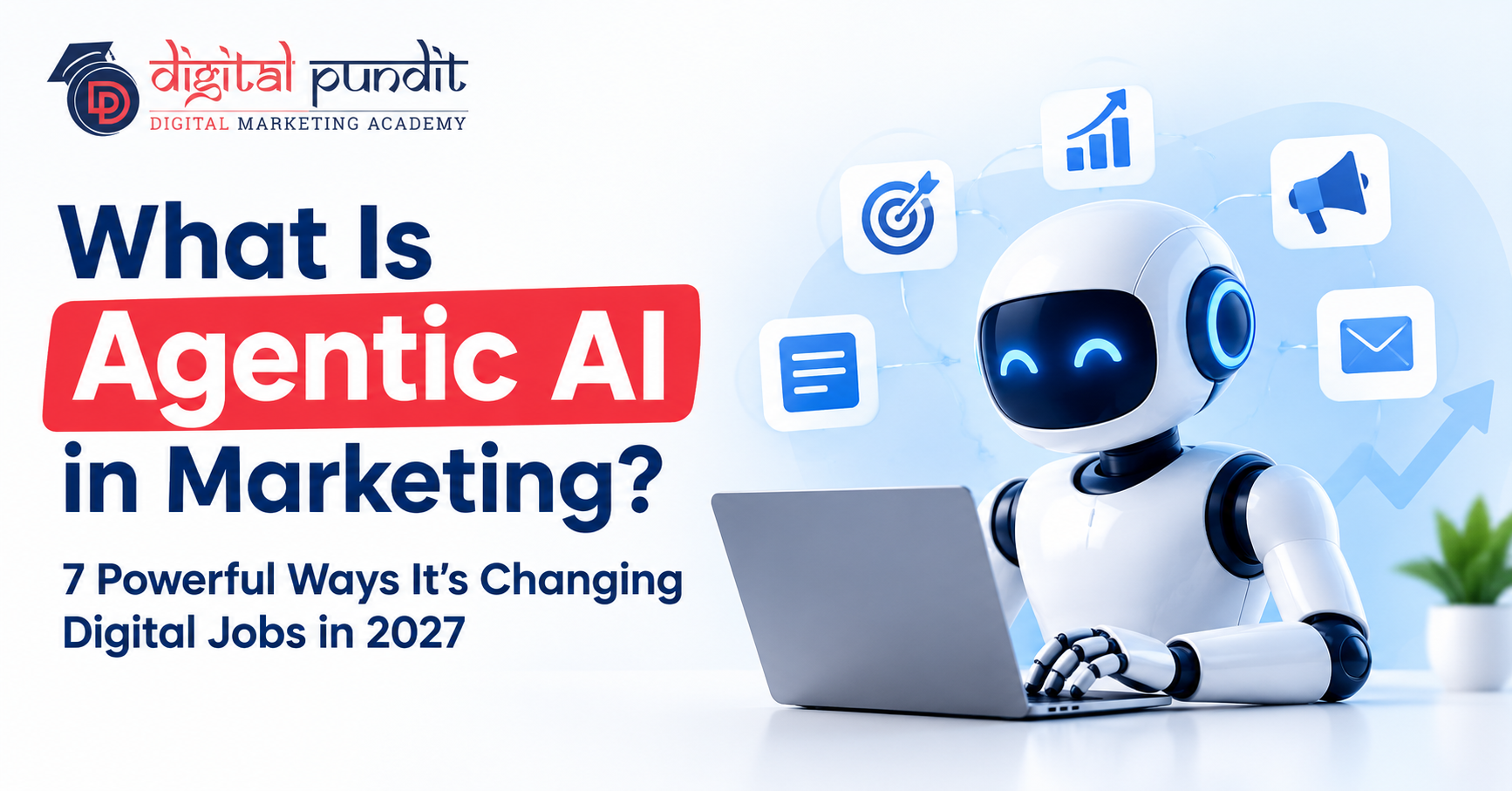
Artificial intelligence is rapidly changing the way businesses approach digital marketing. Until recently, marketers mainly used AI to generate content, analyze data, create images, write ad copy, and automate repetitive tasks. However, the next stage of AI is moving beyond simple assistance. Agentic AI in marketing can understand a goal, plan a series of actions, use different tools, analyze results, and make adjustments with limited human intervention. This evolution is expected to have a major impact on digital marketing jobs and skills as businesses move toward more intelligent and automated marketing operations.
For digital marketing students and professionals, understanding Agentic AI is becoming increasingly important. The future will not necessarily be about AI replacing marketers. Instead, it will be about marketers learning how to work with AI agents, manage automated workflows, interpret AI-generated insights, and make better strategic decisions. By 2027, these skills could become an important part of successful digital marketing careers.
What Is Agentic AI in Marketing?
Agentic AI in marketing refers to artificial intelligence systems that can work toward a specific marketing objective by planning and completing multiple tasks. Unlike traditional AI tools that generally wait for a user to provide individual instructions, an AI agent can work through a larger process based on a defined goal.
For example, a traditional AI tool might be asked to write five social media captions for a product. The user gives the instruction, receives the captions, reviews them, and then decides what to do next. An agentic AI system could work toward a broader objective such as increasing qualified leads. It may analyze previous campaign performance, research the target audience, suggest content ideas, create variations, monitor performance, and recommend the next action.
This makes Agentic AI different from simple content-generation tools. The focus is not only on producing an answer but on achieving an objective through a series of connected actions.
Agentic AI vs Traditional Marketing Automation
Agentic AI should not be confused with traditional marketing automation. Automation generally works according to predefined rules. For example, when a customer fills out a form, an automated system may send a particular email. The process remains fixed unless someone changes the workflow.
Agentic AI can potentially operate in a more flexible and goal-oriented way. Instead of following only one predefined sequence, it can evaluate information, decide what action may be appropriate, execute that action, and analyze the outcome. This can make marketing workflows more adaptive.
The difference is important because marketers may increasingly move from manually operating individual tools to managing AI-powered systems that connect research, content, advertising, analytics, CRM, and customer communication.
7 Powerful Ways Agentic AI Is Changing Digital Jobs in 2027
1. Digital Marketers Will Manage AI Agents Instead of Only Marketing Tools
One of the biggest changes in digital marketing jobs could be the shift from operating individual platforms to managing AI-powered marketing systems. Digital marketers traditionally spend considerable time working with platforms such as Google Ads, Meta Ads, analytics tools, SEO platforms, email marketing software, and social media management systems.
As AI agents become more capable, marketers may increasingly give these systems broader objectives instead of performing every individual task manually. A marketer could define a campaign goal, audience, budget, brand guidelines, and performance targets. The AI agent could then assist with research, campaign preparation, monitoring, reporting, and optimization.
This means marketers will need to understand how AI systems make decisions and how to provide them with appropriate instructions and limitations. Human supervision will remain important because marketing decisions can affect brand reputation, customer relationships, and business performance.
The role of the marketer could therefore evolve from simply being a marketing tool operator to becoming an AI-powered marketing strategist.
2. SEO Professionals Will Focus More on AI Search and Brand Visibility
SEO is also changing.
For years, the primary objective was to rank webpages on traditional search engines for specific keywords.
But consumers are increasingly using AI systems to discover information, compare products, and make decisions.
This creates a new challenge for marketers:
How does a brand become visible when an AI agent is deciding what information or product to recommend?
Marketing teams will therefore need to think about:
- Search visibility
- AI-generated answers
- Brand authority
- Structured information
- Reviews
- First-party data
- Content quality
- Entity recognition
- Generative Engine Optimization (GEO)
In an agentic environment, being technically optimized for search may not be enough. A brand must also provide trustworthy, consistent information that AI systems can understand and use.
BCG notes that AI agents are increasingly influencing how customers discover, evaluate, and buy products, meaning brand strategy must adapt to agent-mediated customer journeys.
This could create new career opportunities such as:
AI Search Strategist, GEO Specialist, AI Content Strategist, and AI Visibility Specialist.
3. Performance Marketing Will Become More Automated and Data-Driven
Performance marketing requires continuous monitoring and optimization. Marketers regularly analyze clicks, impressions, conversion rates, cost per lead, return on ad spend, audience performance, and creative results.
Agentic AI can potentially take over many repetitive parts of this process. An AI system could monitor campaign performance, identify unusual changes, compare different audiences, evaluate creative performance, and suggest optimization opportunities.
For example, if one campaign starts producing significantly better-quality leads than another, an AI agent could identify the change and provide recommendations based on the available data. Depending on the system and permissions, it could potentially make certain predefined adjustments automatically.
This does not mean performance marketers will become unnecessary. Instead, their focus can move toward campaign strategy, experimentation, business objectives, audience understanding, and decision-making.
The future performance marketer may spend less time making small manual changes and more time determining why a campaign is working and how it can support larger business goals.
4. Content Marketing Will Move From Content Creation to Content Strategy
AI has already changed content marketing by making it easier to create articles, captions, scripts, emails, and other content formats. Agentic AI can take this development further by connecting multiple content activities into one workflow.
Instead of simply asking AI to write a blog, a marketer could give an agent a broader content objective. The system could research a topic, understand the target audience, analyze competing content, prepare an outline, draft the article, suggest optimization opportunities, create social media versions, and analyze content performance.
This could dramatically reduce the amount of time marketers spend on repetitive content production.
However, human creativity will continue to matter. AI can produce content quickly, but marketers still need to decide what the brand should communicate, what tone should be used, what ideas are valuable, and what information is genuinely useful to the audience.
As a result, content marketers may increasingly become content strategists and creative directors rather than simply content producers.
5. Social Media Managers Will Become More Strategic
Social media management includes many repetitive activities, including content planning, caption writing, scheduling, performance reporting, audience analysis, and content repurposing. Agentic AI could help connect these tasks into a more intelligent workflow.
For example, an AI system could analyze several months of social media performance and identify patterns in audience behavior. It might discover that educational content receives stronger engagement than promotional content or that certain topics generate more website visits.
The system could then help create future content recommendations based on those patterns.
However, social media cannot be managed successfully through data alone. Culture, emotions, humor, trends, community relationships, and brand reputation are extremely important. An AI system may optimize for engagement but fail to understand how a particular message could affect the brand.
Therefore, social media professionals will still need strong communication skills, creative judgment, audience understanding, and reputation-management abilities. Their role may become more strategic as AI handles more repetitive work.
6. Marketing Analysts Will Become Decision Strategists
Modern businesses collect huge amounts of marketing data from websites, advertising platforms, social media, CRM systems, email campaigns, e-commerce platforms, and customer interactions. Traditionally, marketing analysts have spent considerable time collecting, organizing, and reporting this information.
Agentic AI can potentially automate parts of this process by continuously examining marketing data and identifying important changes or patterns.
Instead of simply receiving a report showing that website traffic increased while conversions decreased, marketers could use AI systems to investigate possible reasons behind the change and identify areas that require attention.
This means marketing analysts will need to become better at interpreting information rather than simply collecting it. They will need to understand business objectives, customer behavior, attribution, experimentation, data quality, and AI-generated insights.
The valuable skill will increasingly be the ability to answer one important question:
“What should the business do next based on this information?”
That is where human judgment becomes extremely important.
7. New AI-Focused Digital Marketing Jobs Will Emerge
Whenever technology changes the way businesses work, new job opportunities can emerge. Agentic AI is likely to create demand for professionals who understand both marketing and AI technology.
Businesses may need people who can design AI-powered marketing workflows, manage AI agents, optimize brands for AI search, develop automated content systems, analyze AI-generated marketing insights, and connect different marketing platforms.
This could result in roles such as AI marketing strategist, AI automation specialist, AI search specialist, AI content strategist, marketing automation architect, and marketing data analyst.
These roles demonstrate an important change in the digital marketing industry. Employers may increasingly value professionals who understand not only how to use marketing platforms but also how to connect those platforms with AI systems to achieve measurable business objectives.
Will Agentic AI Replace Digital Marketers?
The possibility of AI replacing jobs is one of the biggest concerns among students and professionals. However, the impact of Agentic AI is likely to be more complicated than simply eliminating digital marketing jobs.
Some repetitive marketing activities will become easier to automate. Tasks involving basic reporting, repetitive content creation, data organization, and routine campaign monitoring may require less manual effort.
At the same time, businesses will continue to need people who understand customers, brands, creativity, strategy, communication, and business objectives. AI can provide recommendations and perform actions, but organizations still need humans to establish goals, evaluate risks, make important decisions, and maintain accountability.
This means the digital marketer of the future may not compete with AI. Instead, the marketer who knows how to use AI effectively may have an advantage over someone who does not.
What Skills Should Digital Marketers Learn for 2027?
Digital marketing professionals should start preparing for this change by developing a combination of marketing, technology, analytical, and creative skills.
Understanding AI and AI agents will become increasingly important. However, professionals should not focus only on learning individual AI tools because tools can change quickly. A stronger approach is to understand how AI can support research, content, analytics, automation, advertising, customer journeys, and decision-making.
Strong digital marketing fundamentals will remain equally important. SEO, social media marketing, paid advertising, email marketing, content marketing, conversion optimization, and analytics provide the foundation on which AI-powered marketing systems operate.
Data analysis will also become more valuable. Marketers need to understand what their numbers mean instead of simply generating reports. Creativity, strategic thinking, communication, and customer psychology will remain important because these are areas where human understanding can add significant value.
Finally, marketers should learn how to evaluate AI output. AI can produce incorrect information or make inappropriate recommendations. A successful digital marketer will need to know when AI can be trusted, when information needs to be verified, and when a human should make the final decision.
How Students Can Prepare for Agentic AI in Marketing
Students entering digital marketing in 2027 shouldn’t be afraid of AI.
Instead, they should learn to work with it.
A strong learning approach could be:
Digital Marketing Fundamentals → AI Tools → Automation → Analytics → AI Agents → Strategy
Students should also practice with real projects instead of learning only theory.
For example, a student could build a small marketing workflow that:
- Researches keywords
- Creates a content brief
- Produces content
- Generates social posts
- Tracks performance
- Creates a report
- Suggests improvements
This kind of practical experience can demonstrate that the student understands not just how to use AI, but how to connect AI with actual marketing objectives.
The Future of Digital Marketing Jobs in 2027
Agentic AI could fundamentally change how digital marketing teams operate. Instead of having separate people manually complete every small task, businesses may use AI-powered systems to coordinate research, content, advertising, analytics, and customer communication.
This doesn’t necessarily mean humans will disappear from the process. Instead, human responsibilities may move toward higher-value activities.
The marketer sets the objective. AI helps research and execute. AI monitors the results. Humans evaluate the outcomes and make important strategic decisions.
This creates a new type of digital marketer: someone who understands both marketing strategy and intelligent technology.
The professionals who adapt to this environment will have an opportunity to become more productive and take on more strategic responsibilities.
Conclusion
Agentic AI in marketing represents the next major stage in the evolution of digital marketing. Instead of using AI only for individual tasks, businesses can increasingly use intelligent systems to manage connected marketing workflows and work toward specific objectives.
The impact on digital jobs in 2027 could be significant. SEO professionals may need to understand AI search, performance marketers may work alongside intelligent optimization systems, content marketers may become more strategic, social media managers may focus more on creative direction, and marketing analysts may become decision strategists.
For students and professionals, the right response is not to avoid AI but to understand it. Learning digital marketing fundamentals while developing skills in AI, automation, analytics, creativity, and strategy can help professionals stay relevant as the industry evolves.
For learners who want to build a strong foundation in digital marketing and understand how the industry is changing with new technologies, Digital Pundit can help develop the practical knowledge and skills needed to prepare for the next generation of digital marketing careers.
The future of digital marketing is not simply AI replacing humans. It is skilled marketers using AI to work smarter, faster, and more strategically.