

Introduction
The digital marketing industry is experiencing a major transformation as artificial intelligence changes how people search for information online. For years, search engines such as Google have helped users discover websites by displaying a list of relevant links. Today, AI-powered search tools are changing this experience by providing direct answers, summarizing information, and recommending useful resources. For students and aspiring professionals pursuing a digital marketing course, understanding these changes is becoming essential for developing relevant skills and building a successful career in the evolving digital landscape.
AI search is not simply another technology trend. It is changing how users discover brands, compare products, research services, and make purchasing decisions. Tools powered by generative AI can understand questions written in natural language and provide answers based on information gathered from different sources. As a result, businesses must rethink their traditional search engine optimization strategies and focus on delivering helpful, trustworthy, and well-structured content. Digital marketers who learn how AI search works can adapt their strategies, improve brand visibility, and prepare for the future of online marketing.
What Is AI Search?
AI search refers to search experiences that use artificial intelligence to understand user queries, interpret context, and generate relevant answers. Traditional search engines generally display a list of web pages that users can visit to find information. AI-powered search experiences may combine information from multiple sources and present a summarized response directly on the results page or within a conversational interface.
For example, a user searching for the best digital marketing institute in Ahmedabad may traditionally receive a list of websites, advertisements, maps, and reviews. An AI-powered search experience may instead summarize important factors, such as course topics, practical training, learning formats, and career support, while referencing relevant sources.
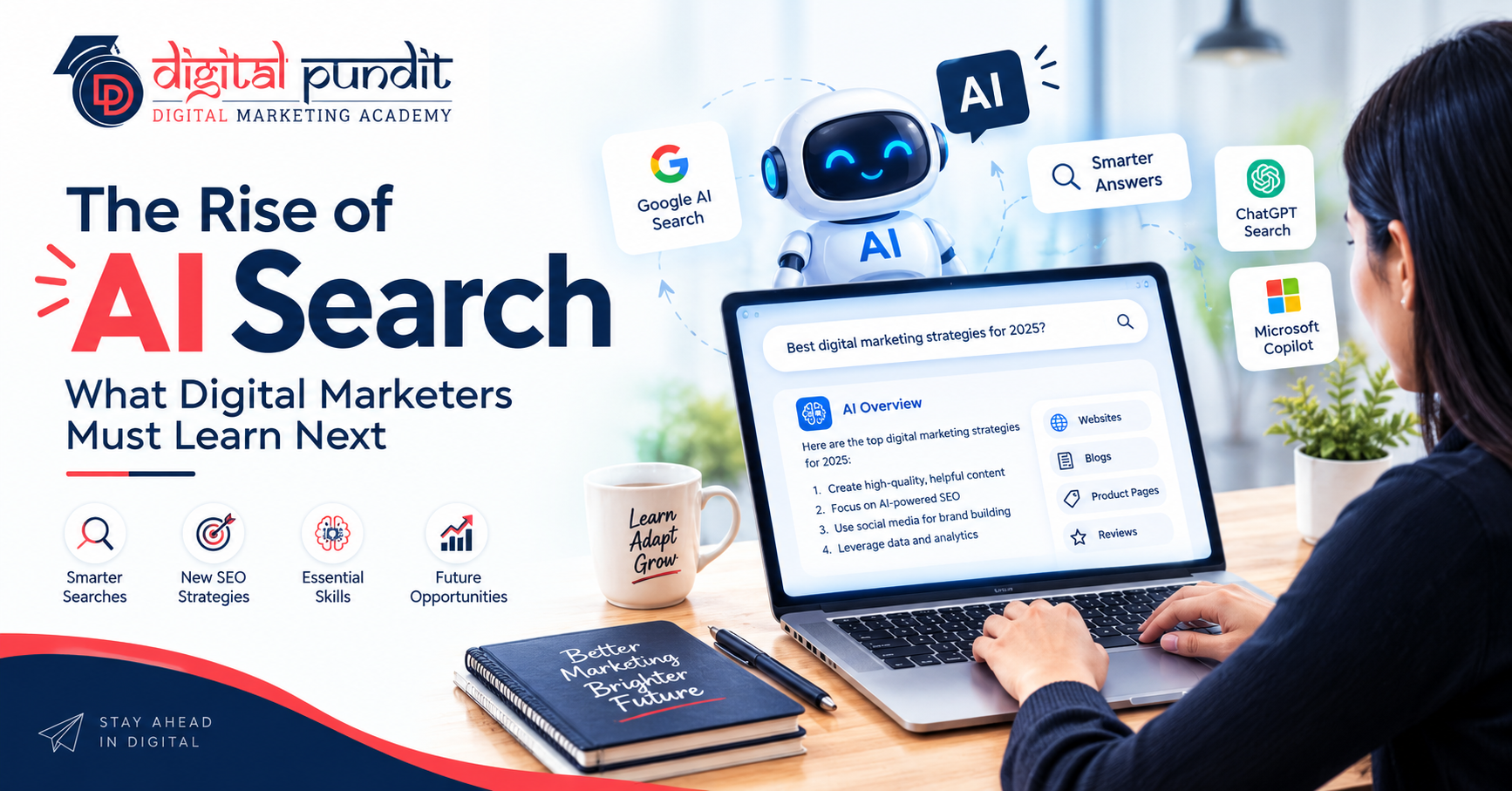
AI search is developing across products such as Google’s AI search experiences, ChatGPT search, and Microsoft Copilot. Although these platforms differ in how they retrieve and present information, they share an important goal: helping users find relevant answers more efficiently.
For digital marketers, this means that visibility is no longer only about securing a high position in a traditional list of search results. Brands also need useful content that search systems can understand, trust, reference, and present when answering relevant questions.
How AI Is Changing Traditional Search Engine Optimization
Traditional SEO has focused on improving website rankings through keyword research, content optimization, backlinks, technical performance, and user experience. These practices remain important, but AI search introduces additional considerations.
One major change is the growing importance of search intent. Instead of entering a short phrase such as “SEO services,” users may ask a detailed question like, “How can a small business improve its Google rankings and attract more local customers?” AI-powered systems are designed to interpret the meaning behind these longer queries and provide contextually relevant answers.
This makes it important for marketers to create content that addresses the real questions customers ask. A page should not simply repeat a keyword multiple times. It should explain the topic clearly, answer related questions, provide practical examples, and help readers make informed decisions.
Another change is that users may receive an answer without clicking through to a website. This can reduce clicks for some informational searches, although the impact varies by query and search platform. At the same time, appearing as a cited or recommended source can introduce a brand to users who might not otherwise discover it.
Therefore, modern SEO should focus on a broader set of outcomes: relevant search visibility, qualified website traffic, brand recognition, customer trust, and conversions.
Why AI Search Matters for Digital Marketers
AI search matters because it influences how potential customers discover information and evaluate businesses. A company may publish excellent content, but if that content is difficult to understand, outdated, or poorly organized, it may be less useful to both readers and AI-powered search systems.
Businesses need to understand that online visibility involves more than publishing blogs and targeting popular keywords. It requires building a consistent digital presence through high-quality website content, credible information, technical SEO, relevant mentions, and a strong reputation.
For example, a local service provider can strengthen its online presence by maintaining accurate business information, explaining its services in detail, publishing helpful answers to customer questions, and collecting genuine customer reviews. These activities help people evaluate the business and may support its discoverability across search experiences.
AI search also creates opportunities for smaller businesses. A company that consistently publishes expert, specific, and useful content can demonstrate its knowledge without relying entirely on a large advertising budget. However, visibility is never guaranteed, and marketers should continue measuring performance across traditional and AI-powered channels.
Key Skills Digital Marketers Must Learn Next
1. Advanced Search Intent and Keyword Research
Keyword research remains an essential SEO skill, but marketers need to look beyond search volume and keyword difficulty. They should understand the questions, problems, motivations, and decisions behind each query.
This involves identifying informational, commercial, transactional, and navigational intent. Marketers should also research conversational queries, follow-up questions, comparisons, and location-specific searches.
For instance, instead of targeting only “digital marketing course,” a marketer could create useful content around questions such as what students learn in a digital marketing course, which skills employers expect, and how beginners can build practical experience.
By organizing related questions into topic clusters, marketers can create content that addresses a subject comprehensively instead of producing disconnected articles for individual keywords.
2. AI-Friendly Content Creation
AI-powered search systems need to understand the information presented on a website. Marketers should therefore write content that is clear, logically organized, accurate, and genuinely helpful.
Effective content usually includes descriptive headings, concise explanations, relevant examples, supporting evidence, and answers to specific questions. Important information should be easy to find rather than hidden inside vague introductions or unnecessarily complicated paragraphs.
However, writing for AI does not mean creating robotic content or filling every paragraph with keywords. The primary audience remains human readers. Content should sound natural, demonstrate real knowledge, and offer value that generic summaries cannot easily replace.
AI writing tools can assist with research, outlining, editing, and brainstorming. Nevertheless, marketers must fact-check AI-generated information, remove unsupported claims, and add original insights, expertise, and relevant examples.
3. Generative Engine Optimization (GEO)
Generative Engine Optimization, commonly called GEO, refers to strategies intended to improve a brand’s visibility in AI-generated answers and search experiences.
The field is evolving, and there is no universal formula that guarantees inclusion in an AI response. Nevertheless, several practical approaches can help businesses strengthen their digital presence.
These include publishing accurate and informative content, clearly identifying products and services, supporting claims with credible sources, maintaining consistent brand information, and earning relevant mentions from trustworthy websites.
Marketers should also structure pages so that important questions and answers are easy to understand. Definitions, comparisons, step-by-step explanations, and well-organized supporting details can make information more useful to readers and easier for search systems to interpret.
GEO should complement established SEO practices rather than replace them. Technical accessibility, useful content, strong website performance, and relevant authority remain important foundations.
4. Technical SEO and Structured Data
Technical SEO helps search engines discover, crawl, and understand website content. These fundamentals remain valuable as search experiences evolve.
Digital marketers should understand XML sitemaps, robots.txt, canonical tags, internal linking, page indexing, mobile usability, website speed, and HTTPS. They should also learn how structured data, such as relevant Schema.org markup, can describe information about products, organizations, articles, and local businesses.
Structured data can help search engines interpret content, but it does not guarantee better rankings or inclusion in AI-generated answers. Marketers must ensure that markup accurately reflects the visible content on their pages and follows the relevant platform guidelines.
It is equally important to ensure that essential content is accessible to search crawlers. A technically sound website provides a stronger foundation for organic search visibility and helps businesses avoid preventable indexing problems.
5. Brand Authority and Digital PR
As AI-powered systems draw on information from different sources, a brand’s wider digital reputation becomes an important area to monitor. Businesses should communicate consistent, verifiable information across their websites, business profiles, industry directories, and relevant publications.
Digital PR can support this process by helping brands earn genuine media coverage, expert mentions, industry partnerships, and useful backlinks. Publishing original research, sharing expert commentary, and contributing meaningful insights to industry discussions can also strengthen credibility.
The objective is not to mention a brand everywhere or manipulate AI systems through artificial repetition. Instead, marketers should build a reputation that people can independently verify.
For example, a digital marketing agency can demonstrate its expertise through detailed case studies, transparent service pages, useful marketing guides, and evidence of its work. Such resources help prospective clients understand the agency’s capabilities and make better decisions.
6. Data Analytics and AI Search Performance Tracking
The growth of AI search makes measurement more complex. Traditional SEO metrics such as organic impressions, clicks, keyword positions, conversions, and engagement remain essential, but marketers may also need to investigate how their brands appear in AI-generated answers.
Useful methods include reviewing referral traffic from AI platforms where available, monitoring branded search trends, examining customer discovery surveys, tracking qualified leads, and manually checking representative queries across relevant search experiences.
Marketers should distinguish measurable results from assumptions. A brand appearing in an AI-generated answer does not automatically mean that it will generate more sales, and an increase in branded searches cannot always be attributed to AI search.
Combining analytics data with customer feedback and conversion tracking provides a more complete picture of whether visibility improvements are producing meaningful business results.
7. AI Tools and Automation
AI tools can make digital marketing workflows faster and more efficient. Marketers can use them to brainstorm topics, organize research, classify search queries, analyze content gaps, develop outlines, summarize large datasets, and generate initial drafts.
Automation can also support repetitive activities such as reporting, content audits, and campaign monitoring. This gives marketers more time to focus on strategy, creativity, customer understanding, and performance improvement.
However, automation should not replace professional judgment. AI tools can produce inaccurate information, miss important context, and generate content that sounds similar to existing material. Human review remains essential, particularly when publishing factual claims or making business decisions.
The most valuable skill is learning how to combine AI tools with marketing knowledge instead of depending on them to make every decision.
Practical Steps to Prepare for the Future of AI Search
Digital marketers do not need to change their entire SEO strategy overnight. Instead, they can start with a few practical improvements that build a stronger foundation for both traditional and AI-powered search.
First, audit your existing website content. Identify pages that contain outdated information, generic explanations, or unanswered customer questions. Update these pages with accurate details, practical examples, and useful insights. Remove unnecessary repetition and ensure every page serves a clear purpose.
Second, strengthen your website’s technical foundation. Check whether important pages are indexed, improve internal linking, maintain a mobile-friendly design, and ensure that essential content is accessible to search engines. Keep your business information accurate across relevant online platforms.
Third, develop a topic-based content strategy. Rather than publishing random blogs, create connected content around your main services and areas of expertise. For example, a digital marketing agency could publish guides about SEO, Google Ads, social media marketing, conversion optimization, and AI search trends. Each article should provide distinct value and link naturally to relevant pages.
Finally, measure meaningful results. Review search impressions, organic traffic, leads, conversions, and engagement. Where available, investigate how your content appears in AI-powered search experiences. Use the findings to improve your strategy instead of relying on assumptions about which techniques work.
Common Mistakes to Avoid in AI Search Optimization
One of the biggest mistakes is assuming that AI search requires completely different SEO rules. In reality, established SEO practices remain an important foundation for Google’s AI search experiences. Creating helpful, reliable content and maintaining a technically accessible website are still essential.
Another mistake is publishing large quantities of AI-generated articles without reviewing their quality. Content that repeats existing information without adding original value may struggle to differentiate a brand. Marketers should prioritize accuracy, expertise, originality, and usefulness over publishing frequency alone.
Businesses should also avoid keyword stuffing, artificial brand mentions, misleading claims, and promises of guaranteed AI search rankings. No legitimate SEO strategy can guarantee that a particular website will be cited in every AI-generated answer.
Instead, marketers should focus on building long-term credibility, understanding their audiences, and creating content that genuinely helps people solve problems. These principles support a more sustainable digital marketing strategy as search technologies continue to develop.
Conclusion
The rise of AI search represents an important opportunity for businesses and digital marketing professionals. As users increasingly interact with AI-powered search experiences, marketers must develop a broader understanding of content strategy, technical SEO, brand authority, analytics, and artificial intelligence. Digital Pundit can help aspiring marketers and professionals understand these evolving digital trends and develop the practical skills needed to adapt to a changing industry.
The future of search will reward businesses that focus on delivering genuine value, communicating clearly, and building trust with their audiences. Marketers who combine traditional SEO knowledge with AI awareness, creative thinking, and data-driven decision-making will be better prepared to respond to new opportunities. Rather than chasing every new trend, they should concentrate on understanding their customers and producing useful, credible content that meets their needs.
For students and professionals who want to develop these skills, enrolling in a digital marketing course can be a practical step toward understanding SEO, content marketing, paid advertising, social media strategy, and AI-powered marketing tools. With structured learning and hands-on practice, aspiring marketers can build a strong foundation for their careers and prepare to succeed in the evolving world of digital marketing.