

Introduction: AI Isn’t Coming for Marketing — It’s Already Here
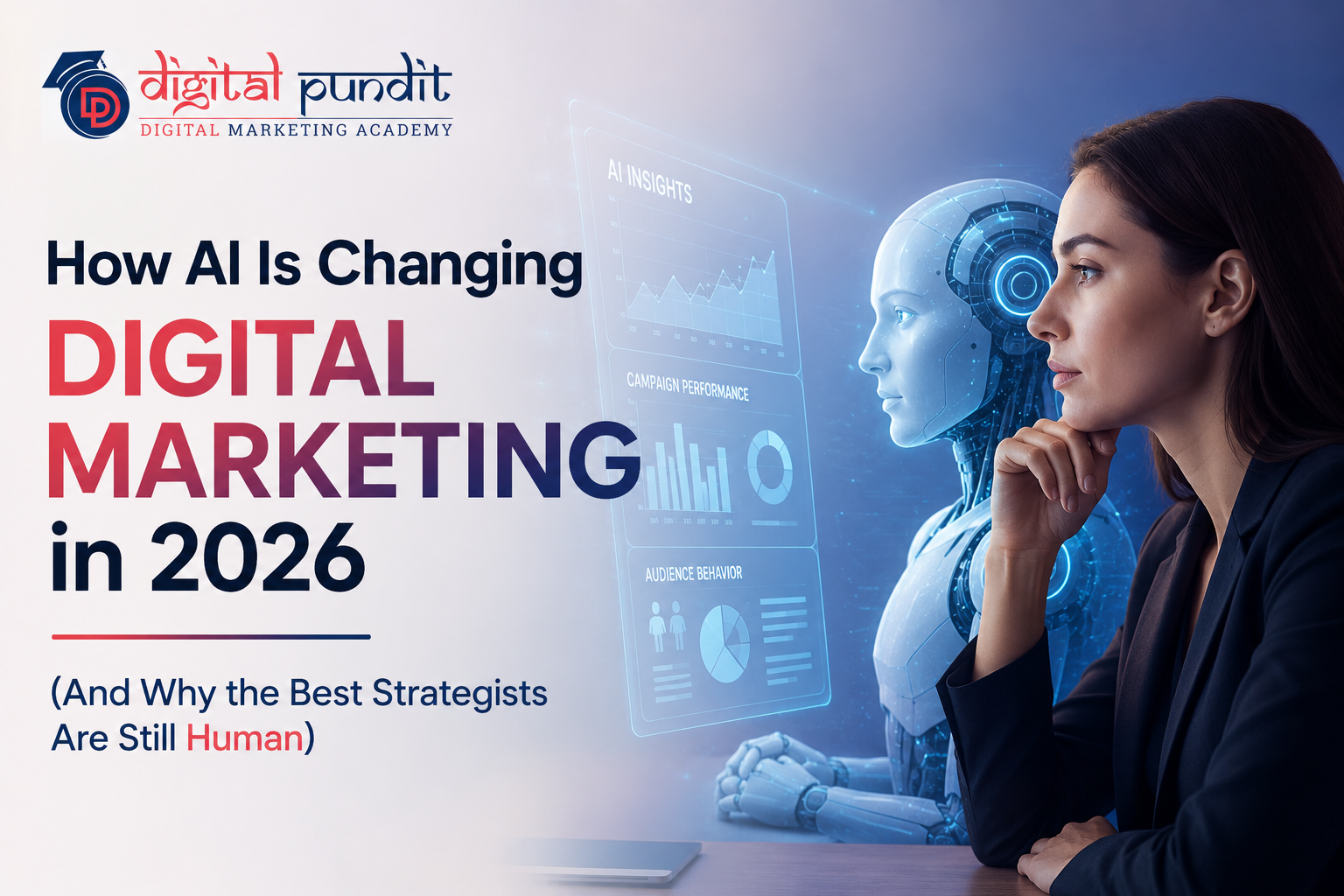
A few years ago, “AI in marketing” mostly meant a chatbot on a website and maybe a recommendation engine on an e-commerce store. That version of AI feels almost quaint now. Walk into any marketing team today — a startup, a large agency, a solo freelancer working from a laptop in Ahmedabad — and you’ll find AI quietly running underneath almost everything: drafting the first version of an email, suggesting the next ad creative, flagging which blog post is about to lose its ranking.
This isn’t a future trend anymore. It’s the operating baseline. According to Salesforce’s State of Marketing 2026 report, generative AI is now used in at least one part of the workflow by 87% of marketers, up from just over half two years earlier. That’s not a slow creep of adoption — that’s a profession rewiring itself in under 24 months.
And yet, ask any marketing director what actually keeps them up at night, and it’s rarely “which AI tool should we buy.” It’s usually something closer to: how do we stand out when everyone has access to the same tools we do? That question is really what this article is about — not whether to use AI in digital marketing (that debate is over), but how to use it in a way that still produces work worth paying attention to.
What Does “AI in Digital Marketing” Actually Mean?
“AI in digital marketing course in ahmedabad” isn’t one thing — it’s a collection of very different capabilities that happen to share the same buzzword. It’s worth separating them, because a marketer who understands the difference makes better decisions than one who just says “we use AI” and leaves it there.
At a practical level, AI in marketing today covers:
- Content generation — drafting blog posts, ad copy, product descriptions, and social captions
- Predictive analytics — forecasting which customers are likely to convert or churn
- Personalization engines — tailoring website content, emails, and offers to individual behavior
- SEO and search intelligence — surfacing keyword gaps, content decay, and technical issues at a scale no human team could match manually
- Campaign optimization — adjusting ad bids, budgets, and creative rotation in real time
- Conversational AI — chatbots and voice assistants that handle support and lead qualification
None of these are hypothetical. All of them are already sitting inside tools that a mid-sized marketing team in India is realistically using this year. The shift isn’t “will AI touch marketing” — it’s which of these six buckets you’re using well, and which ones you’ve barely opened yet.
Traditional Marketing vs. AI-Powered Marketing: A Side-by-Side Look
It helps to see this shift laid out plainly, channel by channel.
| Marketing Function | Traditional Approach | AI-Powered Approach |
|---|---|---|
| SEO | Manual keyword research, gut-feel content briefs | AI-driven keyword clustering, content gap analysis, decay tracking |
| Content Creation | Every draft written from a blank page | AI drafts a first pass; a human shapes tone, argument, and voice |
| Paid Advertising | Manual bid adjustments, fixed audience segments | Real-time bid optimization, dynamic audience targeting |
| Email Marketing | Batch-and-blast campaigns to the whole list | Behavior-triggered, individually personalized sequences |
| Social Media | Manually scheduled posts, guesswork on timing | AI-recommended posting times, auto-generated caption variants |
| Analytics | Monthly manual reports, backward-looking | Real-time dashboards with predictive, forward-looking signals |
Notice what doesn’t change in that table: the strategy row isn’t there, because no AI-Powered Approach column exists for it yet. Deciding why a campaign exists, who it’s really for, and what the brand should sound like while saying it — that’s still a fundamentally human call, and it’s the row every marketer should be spending more time on, not less.
Want to actually build these skills rather than just read about them? Digital Pundit’s practical, hands-on digital marketing course in Ahmedabad is built around exactly this blend — AI tools plus the strategic thinking to use them well.
The Numbers Speak: AI Adoption in Marketing Right Now
The scale of this shift is easier to grasp with a few numbers in front of you:
- 87% of marketers now use generative AI in at least one part of their workflow, up from 51% just two years ago (Salesforce, State of Marketing 2026)
- 88% of marketers report using AI tools on a daily basis, making it the fastest-adopted marketing technology since email itself (SurveyMonkey, 2026)
- AI content drafting delivers the highest documented ROI of any AI marketing application at roughly 3.2x, ahead of personalization engines at 2.7x (McKinsey Global AI Survey)
- The average marketer now saves around 6 hours a week using AI tools — senior practitioners save more, junior staff somewhat less (HubSpot AI Trends 2026)
- Despite all this adoption, skills gaps remain the top challenge, cited by 58% of marketers, with only a small fraction reporting they’ve received proper job-specific AI training (Loopex Digital, 2026)
That last stat is the one worth sitting with. Adoption has outrun training. Most marketing teams have the tools already installed — what they’re missing is people who know how to use them without producing the same generic output as every other team using the same tools.
The Tools Reshaping Everyday Marketing Work
You don’t need to master fifty tools to work effectively in AI-driven marketing — you need to understand a handful deeply. Here’s what’s actually earning a permanent spot in marketers’ workflows this year:
- ChatGPT / Claude — for drafting, brainstorming, and restructuring content quickly
- Semrush / Ahrefs AI features — for keyword research, content gap analysis, and competitive tracking
- Jasper / Copy.ai — for on-brand copy generation at scale across campaigns
- Canva’s AI design tools — for quick creative production without a dedicated designer
- HubSpot / Salesforce AI modules — for lead scoring, email personalization, and CRM automation
- Surfer SEO / Clearscope — for optimizing content structure against what’s already ranking
The common thread across all six: they’re accelerators, not decision-makers. Every one of them still needs a person telling it what “good” looks like for this brand, this audience, this moment.
Where AI Falls Short — And Why Strategy Still Needs a Human Hand
Here’s where it gets uncomfortable for anyone hoping AI will eventually replace the need to think strategically: it consistently struggles with the exact things that make a marketing campaign actually work.
It has no real memory of your brand’s history. AI doesn’t remember that a campaign like this one flopped two years ago, or why a particular tone works with your audience and another doesn’t. A person who’s been in the trenches with the brand carries that context automatically.
It optimizes for “plausible,” not “true.” AI-generated copy can sound confident while being factually wrong or strategically off-target — it’s built to produce fluent text, not to know your market.
It flattens distinctiveness. When every competitor runs the same prompts through the same handful of models, the outputs start to converge. If your content sounds like everyone else’s, AI didn’t fail — it did exactly what it was built to do. The differentiation has to come from somewhere else.
It can’t take responsibility for a decision. Someone still has to decide whether a campaign is on-brand, legally sound, and actually aligned with a quarter’s business goals. AI can inform that judgment call. It can’t make it.
None of this is an argument against using AI — it’s an argument for using it well, which is a very different thing.
The Hybrid Playbook: How Smart Marketers Actually Use AI
The marketing teams pulling ahead right now aren’t the ones avoiding AI, and they’re not the ones handing everything over to it either. They’re running something closer to this workflow:
- Start with a human-defined strategy — the audience insight, the angle, the “why this, why now” that only comes from actually understanding the market
- Use AI to accelerate research — competitive analysis, keyword clustering, and first-draft outlines happen in minutes instead of hours
- Write the first draft with AI, then rewrite the parts that matter — let AI handle structure and pacing, then rewrite the hook, the examples, and anything that needs a real point of view
- Use AI for optimization, not judgment — let it suggest headline variants or ad copy tweaks, but decide yourself which one actually fits the brand
- Have a human do the final review — check for accuracy, tone, and the kind of nuance that only comes from actually knowing the audience
This isn’t slower than pure AI generation by much — but it produces work that doesn’t read like everyone else’s AI output, which increasingly is the entire game.
Ready to build this exact skill set? Digital Pundit’s digital marketing course in Ahmedabad is designed around the hybrid workflow — covering AI tools for SEO, content, ads, and analytics alongside the strategic thinking that decides how to actually use them.
Building a Career in AI-Driven Digital Marketing
If you’re evaluating whether digital marketing is still a smart career path in an AI-heavy world, here’s the honest answer: it’s a better path than it was five years ago, not a worse one — provided you learn the right layer of the skill stack.
The roles disappearing are the purely execution-level ones: manually scheduling posts, writing formulaic product descriptions, running basic keyword lookups by hand. The roles growing are the ones that sit one level up: people who can direct AI tools intelligently, interpret what the data is actually saying, and make the creative and strategic calls that AI still can’t.
That’s exactly the gap a good digital marketing course in Ahmedabad should be built to close — not teaching AI tools in isolation, but teaching how SEO, paid media, content, and analytics fit together, with AI folded in as part of the everyday toolkit rather than treated as a separate module bolted on at the end.
FAQ: People Also Ask
1. Is AI going to replace digital marketers? No — it’s replacing specific tasks, not the role itself. AI is taking over repetitive execution work like scheduling and basic copy drafting, while demand is growing for marketers who can direct AI tools strategically and make the judgment calls AI can’t.
2. What skills do I need for a career in AI-driven digital marketing? Core marketing fundamentals (SEO, content, paid media, analytics) still matter most, layered with practical fluency in AI tools like ChatGPT, Semrush, and AI-powered ad platforms. Strategic thinking and brand judgment matter more, not less, as AI handles more execution.
3. Which AI tools should a beginner in digital marketing learn first? Start with a generative AI assistant (ChatGPT or Claude) for drafting and research, an SEO platform with AI features (Semrush or Ahrefs), and your ad platform’s built-in AI optimization tools — that covers the majority of day-to-day work.
4. Does using AI content hurt SEO rankings? Not inherently — search engines penalize low-quality, unoriginal content, not AI use itself. Thin AI-generated content without real expertise or editing tends to underperform, while AI-assisted content that’s fact-checked, edited, and given a genuine point of view performs well.
5. How much time can AI actually save a marketing team? Industry surveys report marketers saving roughly six hours a week on average using AI tools, with senior practitioners often saving more on research and first-draft work specifically.
6. Is it worth joining a digital marketing course in Ahmedabad instead of learning AI tools on my own? Self-learning can teach you individual tools, but a structured digital marketing course in Ahmedabad teaches how those tools fit into a real campaign — plus the strategic and analytical skills that determine whether a campaign actually works, which is much harder to piece together from scattered tutorials.
7. What’s the biggest mistake marketers make with AI right now? Treating AI output as a finished product instead of a first draft. The teams getting real value are the ones that use AI to move faster through research and structure, then apply human judgment to the parts that actually need a distinct point of view.
Conclusion: Learn the Tools, Keep the Judgment
AI has permanently changed what a digital marketing job looks like day to day — faster research, faster drafts, faster optimization. What it hasn’t changed is what makes a campaign actually work: a real understanding of the audience, a distinct point of view, and the judgment to know which of AI’s suggestions to keep and which to throw out.
That combination — tool fluency plus strategic judgment — is exactly what employers are hiring for right now, and it’s exactly what a well-structured digital marketing course in Ahmedabad should be teaching. If you’re based in Ahmedabad and serious about building a career that uses AI as a genuine advantage rather than a crutch, Digital Pundit runs practical, project-based training designed around this reality — where AI tools are part of the curriculum from day one, not an afterthought bolted onto an outdated syllabus.
The marketers who’ll matter most over the next few years won’t be the ones who avoided AI, and they won’t be the ones who let it do all their thinking either. They’ll be the ones who learned to work with it — and that’s a skill worth actually training for.