

Search is changing.
For years, businesses focused on one primary question: How do I rank on Google?
In 2026, that question has become broader.
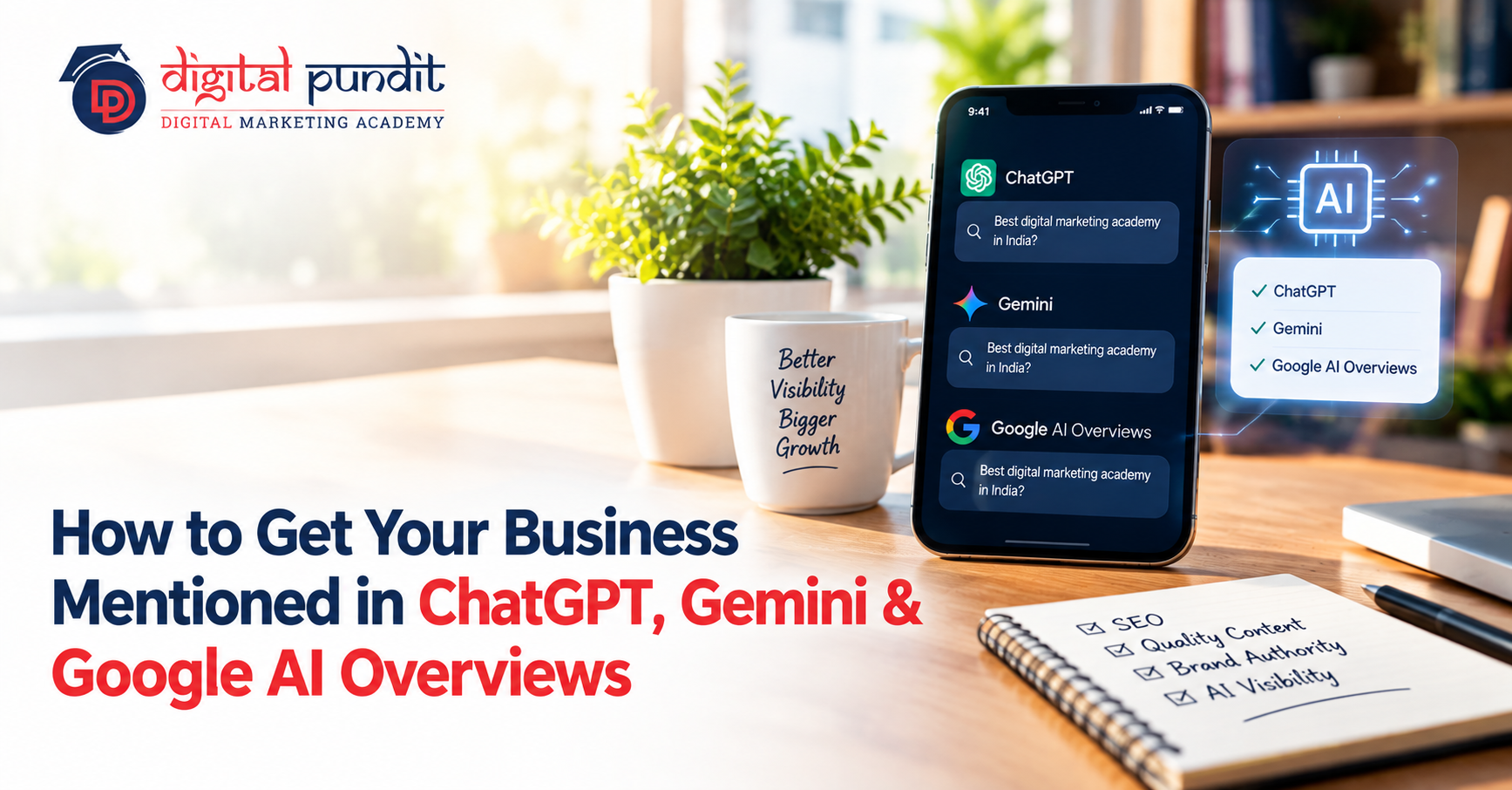
People are increasingly asking AI systems questions such as:
- Which digital marketing institute is good in Ahmedabad?
- Which agency can help a small business with SEO?
- What are the best CRM software options for a growing company?
- Which dental clinic offers a particular treatment near me?
- What should I look for before hiring a digital marketing agency?
Instead of receiving only a traditional list of blue links, users may now receive an AI-generated answer containing summaries, recommendations, citations and links to businesses or websites.
Google has expanded AI Overviews and AI Mode, while ChatGPT can search the web and provide cited sources. Google also introduced additional ways for users to discover original websites and content through its AI search experiences.
That creates a new digital marketing objective:
Don’t just try to rank. Become a source that AI systems can discover, understand, trust and mention.
This is where SEO, Answer Engine Optimization (AEO), Generative Engine Optimization (GEO), local SEO and strong brand authority come together.
What Does It Mean to Be Mentioned by AI?
When someone asks ChatGPT, Gemini or Google an industry-related question, the system may search available information, identify relevant sources and use those sources to construct its answer.
If your website, business profile or other authoritative online references are used in that process, your business may be:
- Mentioned by name
- Included in a recommendation
- Used as a supporting source
- Linked to
- Cited in an answer
- Included in a local or category-based result
This is different from traditional SEO.
Traditional SEO often focuses on getting a webpage into a strong position for a particular keyword.
AI visibility is more about whether your business has clear, consistent and trustworthy information across the web that machines can understand and use.
There is no single switch that guarantees a business will be mentioned by ChatGPT, Gemini or Google’s AI features.
Instead, businesses need to build the signals that make their information useful and discoverable.
AI Search Is Becoming More Conversational
One of the biggest changes in search is the move from short keyword searches to longer, conversational questions.
Someone might previously have searched:
digital marketing course Ahmedabad
Now they might ask:
What are some practical digital marketing courses in Ahmedabad for someone who wants to learn SEO, Google Ads, social media and AI marketing?
The second query contains much more context.
Google has been developing AI Mode and AI Overviews around this type of deeper search experience. Google said in 2026 that AI Mode and AI Overviews were being enhanced to help people explore information and discover relevant websites and original content.
This means your content needs to answer the questions people actually ask, not simply repeat a keyword.
ChatGPT, Gemini and Google AI Overviews Are Not Exactly the Same
It’s important not to treat every AI search platform as one identical system.
| Platform | What businesses should focus on |
|---|---|
| ChatGPT Search | Crawlable website content, clear information, authoritative references and strong topical relevance |
| Google AI Overviews | Traditional SEO, useful content, technical accessibility, structured information and search relevance |
| Google AI Mode | Deeper topical coverage, useful sources, clear answers and strong overall search presence |
| Gemini | Strong Google ecosystem visibility, useful website content and authoritative information |
| Local AI recommendations | Business profiles, location information, reviews, services and consistent business data |
OpenAI states that public websites can appear in ChatGPT search and specifically advises publishers to avoid blocking OAI-SearchBot if they want their content to be discoverable and potentially cited.
Google, meanwhile, continues to emphasize that established SEO practices remain relevant to its generative AI search features. Its 2026 documentation specifically discusses optimizing for generative AI features while noting that traditional SEO best practices continue to matter.
So the strategy isn’t:
SEO is dead.
The more accurate approach is:
SEO is becoming the foundation for AI visibility.
1. Create Content That Directly Answers Real Questions
The first step is surprisingly simple.
Write content that answers questions clearly.
Instead of creating an article titled:
Digital Marketing
create specific resources such as:
How Much Does Digital Marketing Cost in Ahmedabad in 2026?
Or:
What Does a Digital Marketing Course Include?
Or:
How Long Does It Take to Learn Digital Marketing?
AI systems need information they can understand and use.
A page that gives a direct answer, explains the reasoning, provides examples and supports its claims is generally more useful than a page written primarily to repeat keywords.
A useful content structure
Start with the answer.
Then explain it.
Then provide examples.
Then answer related questions.
Then provide supporting evidence.
Then give the reader the next logical step.
This structure works for humans and makes information easier for search systems to interpret.
2. Build Topic Authority Instead of Publishing Random Blogs
One of the biggest mistakes businesses make is publishing unrelated blog posts every week.
Imagine a digital marketing institute publishes:
- Digital marketing course
- Best restaurants in Ahmedabad
- Cricket marketing
- AI tools
- Fashion trends
- Travel tips
- Digital marketing jobs
The website may have many articles, but its topical identity becomes less focused.
Instead, build content clusters.
For example:
Digital Marketing Cluster
Pillar page:
Digital Marketing Course in Ahmedabad
Supporting articles:
- Digital Marketing Course Fees in Ahmedabad
- Digital Marketing Course Syllabus
- Digital Marketing Career Options
- Digital Marketing Salary in Ahmedabad
- SEO vs PPC
- AI in Digital Marketing
- AEO vs GEO vs SEO
- Google AI Mode and SEO
- Digital Marketing Skills in 2026
- How to Build a Digital Marketing Funnel
These pages can internally link to each other.
Over time, your website creates a much clearer topical footprint.
3. Write Answer-First Content
AI search is highly conversational.
That means your content should contain sections where the answer is immediately obvious.
For example:
What is GEO in digital marketing?
GEO, or Generative Engine Optimization, is the process of improving a brand’s online visibility so that generative AI systems can understand, retrieve and potentially reference its information when answering user questions.
Then expand on the topic.
Don’t make users or AI systems dig through five paragraphs before reaching the actual answer.
This is one of the easiest improvements you can make to existing content.
4. Make Your Business Information Extremely Clear
AI systems need to understand what your business actually does.
Your website should clearly communicate:
- Business name
- Main services
- Products
- Location
- Areas served
- Contact information
- Experience
- Industry specialization
- Team information
- Credentials
- Case studies
- Reviews
- Frequently asked questions
For example, if you operate a digital marketing agency, don’t simply say:
We provide complete digital solutions.
That’s vague.
A clearer description would explain:
We provide SEO, Google Ads, social media marketing, website development and AI-focused digital marketing services for businesses in Ahmedabad and across India.
Specific information is easier to interpret.
5. Strengthen Your Google Business Profile and Local SEO
For local businesses, this is critical.
If someone asks:
Who provides digital marketing services near me?
or:
Which digital marketing institute is available in Ahmedabad?
the AI system needs reliable location and business information.
Make sure your:
- Google Business Profile
- Website
- Address
- Phone number
- Business category
- Service descriptions
- Working hours
- Reviews
- Social profiles
are consistent.
Your website should also have dedicated location and service pages where appropriate.
Google’s search documentation continues to support structured information for business entities and local businesses, making clear, machine-readable business information an important part of search visibility.
6. Build Real Reviews and First-Hand Experiences
Reviews are no longer just about getting a higher star rating.
They also provide additional language around your business.
For example, a generic review says:
Great service. Highly recommended.
A detailed review might explain:
We hired the agency for SEO and Google Ads. They improved our local visibility and helped generate leads from Ahmedabad.
The second review provides considerably more contextual information.
Businesses should encourage customers to leave genuine, detailed reviews based on their actual experience.
Don’t manufacture reviews.
Don’t stuff keywords into reviews.
Don’t ask customers to publish something they didn’t experience.
Authenticity matters more than artificial optimization.
7. Create Original Information AI Can Reference
This is becoming increasingly important.
If every website publishes the same generic article about:
10 Benefits of Digital Marketing
there is little reason for an AI system to treat one version as particularly valuable.
Original information gives your website something different.
Consider publishing:
- Original research
- Surveys
- Industry statistics
- Case studies
- First-hand experiments
- Pricing analysis
- Expert interviews
- Original screenshots
- Customer questions
- Before-and-after results
- Local market research
For example:
What 100 Ahmedabad Businesses Are Spending on Digital Marketing in 2026
is potentially much more distinctive than another generic article titled:
Benefits of Digital Marketing.
Google’s current guidance specifically highlights the importance of non-commodity content for generative AI search visibility.
8. Earn Mentions Beyond Your Own Website
AI visibility isn’t only about your website.
Your brand can also be discussed across:
- Industry publications
- News websites
- Business directories
- YouTube
- Podcasts
- Interviews
- Local publications
- Partner websites
- Industry communities
Think about it this way.
Your website says:
We are experts in digital marketing.
An independent publication says:
Digital Pundit provides digital marketing training in Ahmedabad.
A LinkedIn post discusses your founder’s experience.
A YouTube interview explains your approach.
A customer talks about your services.
Together, these create a broader digital identity.
That can be much more meaningful than simply publishing hundreds of blog posts.
9. Make Your Website Easy for Search Crawlers to Access
This is the technical foundation.
If search crawlers cannot access your content, your content has limited opportunity to appear in search-driven AI experiences.
For ChatGPT specifically, OpenAI says websites should not block OAI-SearchBot if they want their content to be discovered, surfaced and cited in ChatGPT search.
For Google, make sure important pages are:
- Crawlable
- Indexable
- Internally linked
- Mobile-friendly
- Fast enough for users
- Canonicalized correctly
- Not accidentally blocked by robots.txt or noindex directives
Also maintain a clean XML sitemap and monitor indexing through Google Search Console.
10. Don’t Ignore Structured Data
Structured data helps search engines understand entities and page content.
Depending on your business, relevant markup may include:
- Organization
- LocalBusiness
- Article
- Breadcrumb
- Product
- Service-related information where applicable
- Profile information
Structured data does not guarantee AI visibility.
But it can help search engines understand the information contained on your website.
Google continues to document structured data as a way to help Search understand webpage content.
11. Create Content Around Follow-Up Questions
Here’s an important shift.
Don’t think only about the first question.
Think about the next five questions.
For example:
Main question
What is the best digital marketing course for beginners?
Potential follow-up questions:
- How much does it cost?
- How long is the course?
- Is placement available?
- Is practical training included?
- Does it teach AI tools?
- Is SEO included?
- Can a commerce student learn it?
- Can I learn digital marketing without coding?
Create content that addresses these connected questions.
This creates a deeper knowledge structure around your topic.
12. Use FAQs, But Don’t Treat FAQ Schema as a Shortcut
FAQs are excellent for users and can help organize useful information.
But there is an important 2026 update.
Google removed support for the FAQ rich result feature in Search in 2026. Its documentation update states that FAQ rich results are no longer shown in Google Search.
That doesn’t mean FAQs are useless.
Quite the opposite.
FAQs remain valuable because real users have questions.
The mistake is creating FAQs purely for a search-engine feature.
Write FAQs because they genuinely answer customer concerns.
13. Keep Your Content Updated
AI search changes quickly.
Information that was accurate in 2024 may be outdated in 2026.
For important pages, review:
- Statistics
- Pricing
- Product information
- Google features
- AI tool capabilities
- Industry developments
- Dates
- Screenshots
- Internal links
- External references
Add a visible:
Last updated: September 2026
when appropriate.
But don’t change the date without actually improving the article.
14. Measure AI Visibility Instead of Guessing
AI visibility is harder to measure than traditional keyword rankings.
Don’t rely on one test.
Create a list of questions that potential customers might ask.
For example:
| Question | Platform | Is brand mentioned? | Is website cited? | Competitors mentioned? |
|---|---|---|---|---|
| Best digital marketing institute in Ahmedabad | ChatGPT | Yes/No | Yes/No | Track |
| Digital marketing course for beginners | Google AI | Yes/No | Yes/No | Track |
| Best SEO agency Ahmedabad | ChatGPT | Yes/No | Yes/No | Track |
| AI marketing course Ahmedabad | Gemini | Yes/No | Yes/No | Track |
| Digital marketing course fees Ahmedabad | Google AI | Yes/No | Yes/No | Track |
Repeat the test periodically.
Don’t expect identical results every time. AI-generated answers can vary based on query wording, location, available sources and other factors.
Google has also introduced reporting controls and a Generative AI performance report in Search Console to help site owners understand performance in its generative AI search features.
The 2026 AI Visibility Framework
If you want a simple framework, think about these six areas:
| Area | What to improve |
|---|---|
| SEO | Rankings, crawlability, internal links and technical health |
| AEO | Direct answers to real questions |
| GEO | Content that can be understood and referenced by generative AI |
| Local SEO | Business profiles, location signals and reviews |
| Brand Authority | Mentions, publications, expertise and reputation |
| Original Content | Research, data, case studies and first-hand experience |
The strongest strategy isn’t choosing one.
It’s connecting all six.
What Businesses Should Stop Doing
AI search doesn’t mean you should publish 500 AI-generated articles.
In fact, mass-producing generic content can create the opposite problem.
Avoid:
- Copying competitor articles
- Publishing AI-generated content without expert review
- Keyword stuffing
- Fake reviews
- Fake statistics
- Creating dozens of near-identical location pages
- Writing content only because a keyword has search volume
- Making unsupported claims
- Hiding important information from users
- Creating pages with no original value
The goal isn’t to produce more content.
The goal is to produce information worth using.
Google has also clarified that its spam policies apply to generative AI responses in Search, reinforcing that AI-generated search experiences do not bypass its existing quality and spam principles.
Can You Guarantee That ChatGPT or Gemini Will Mention Your Business?
No.
There is no legitimate SEO technique that guarantees a business will be recommended by ChatGPT, Gemini or Google AI Overviews.
AI systems consider multiple signals and can produce different answers for similar questions.
What you can control is your digital footprint:
Make your business easy to discover.
Make your expertise easy to understand.
Make your information accurate.
Build genuine authority.
Publish useful original content.
Maintain consistent business information across the web.
That is a much more sustainable approach than trying to find a secret AI ranking trick.
Final Thoughts
The biggest change in search isn’t simply that Google has added AI.
The bigger change is that users are starting to ask machines to research, compare and summarize information for them.
That changes what visibility means.
A business can no longer depend entirely on ranking one page for one keyword.
Your website needs to communicate what you do.
Your content needs to answer real questions.
Your business information needs to be consistent.
Your brand needs genuine authority.
And your online presence needs to provide enough useful information for search and AI systems to understand your business.
The future of search is not necessarily SEO versus AI.
It is increasingly SEO plus AEO plus GEO plus brand authority plus useful original content.
If your business starts building these assets now, you’re preparing for a search environment where the question isn’t only:
Where does my website rank?
It is also:
When someone asks AI about my industry, does my business have enough useful, trustworthy information to be part of the answer?
That is the question businesses should be preparing for in 2026.
Frequently Asked Questions
1. How can I get my business mentioned in ChatGPT?
Start by making your website publicly accessible and crawlable, publishing useful original content, clearly explaining your products or services and building authoritative references around your brand. OpenAI specifically says websites should not block OAI-SearchBot if they want their content to be discoverable and potentially cited in ChatGPT search.
2. How do I appear in Google AI Overviews?
There is no separate guaranteed ranking system that businesses can simply optimize for. Google says traditional SEO best practices remain relevant to its generative AI search features. Focus on helpful, original content, technical accessibility, strong topical relevance, clear answers and authoritative information.
3. What is GEO in digital marketing?
GEO stands for Generative Engine Optimization. It broadly refers to improving a brand’s online presence so generative AI systems can discover, understand and potentially reference its information when responding to user questions.
4. Is SEO still important because of AI search?
Yes. Google continues to state that SEO best practices remain relevant for its generative AI search experiences. AI search adds another layer of visibility rather than making basic search optimization irrelevant.
5. Does structured data help with AI search?
Structured data can help search engines understand information on a webpage. It doesn’t guarantee that an AI system will mention your business, but it can improve the machine-readable understanding of your website.
6. Do Google reviews help AI visibility?
Genuine reviews can contribute useful information about a local business, its services and customer experiences. Businesses should focus on authentic reviews rather than attempting to manipulate review content.
7. Should I create an llms.txt file for AI SEO?
Don’t treat llms.txt as a magic AI-ranking technique. Google’s June 2026 documentation update clarified that llms.txt isn’t required for Google Search and does not provide a positive or negative ranking effect there.
8. Can AI-generated articles rank in Google?
AI-generated content is not automatically excluded simply because AI was used. The important question is whether the content provides useful value and follows Google’s quality and spam policies. Businesses should add human expertise, original information, fact-checking and genuine experience rather than mass-producing generic pages.
9. How often should I check whether AI mentions my business?
For important commercial queries, checking monthly is a practical starting point. Track a consistent set of questions across relevant AI search platforms and record whether your brand, website or competitors appear.
10. What is the biggest mistake businesses make with AI search?
The biggest mistake is looking for a shortcut.
There is no single prompt, schema tag or AI tool that guarantees visibility.
Businesses are better served by building a strong combination of technical SEO, useful content, topical authority, local presence, genuine reviews, original research and brand mentions.