


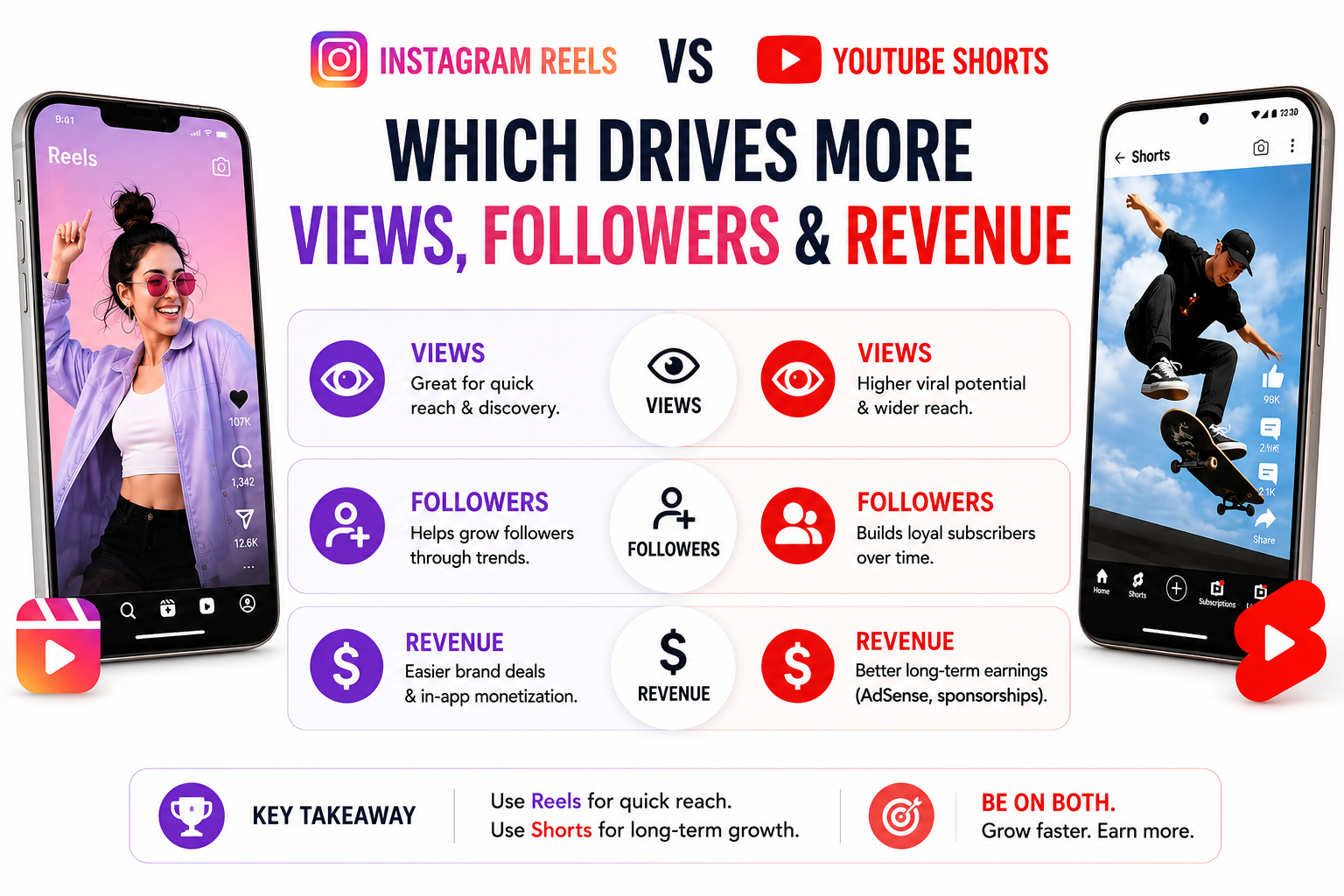
Short-form video is no longer a trend — it is the dominant format in digital marketing right now. Whether you are a brand trying to grow awareness, a creator building an audience, or a business owner running your own social media, you have probably already heard the same debate: Instagram Reels or YouTube Shorts?
The frustrating truth is that most comparisons either oversimplify the answer or bury you in jargon. At Digital Pundit, we work with creators and businesses daily, and we’ve seen firsthand how the wrong platform choice wastes months of effort. This guide gives you clarity — not generic advice. By the end, you will know exactly how each platform’s algorithm works, who the audience really is, what monetization looks like in 2026, and which platform makes sense for your goals.
Why This Comparison Matters More in 2026
Short-form video generates roughly 2.5 times more engagement than long-form content — and both Meta and Google are responding by pouring resources into their short-form products. Instagram Reels and YouTube Shorts are no longer experimental features. They are now central to how billions of people discover content, products, and brands every single day.
But here is what most guides miss: Reels and Shorts are not the same product with different logos. They operate on fundamentally different algorithmic principles, attract audiences with different mindsets, and reward creators for entirely different behaviors. Treating them as interchangeable is one of the most common and costly mistakes content creators make in 2026.
What Is Instagram Reels?
Instagram Reels is Meta’s short-form video product, launched in 2020. Reels allows creators to post vertical videos up to 90 seconds long, with content distributed both to existing followers and to non-followers through the Explore feed and the dedicated Reels tab.
Reels lives inside an ecosystem where social connection already exists. Your followers, the people you follow, and your mutual connections all shape how your content gets initially distributed. Trending sounds, remixes, and audio templates drive a significant portion of Reels discovery — making audio strategy a unique lever that does not exist in the same way on YouTube Shorts.
What Is YouTube Shorts?
YouTube Shorts is Google’s short-form video format: vertical videos under 60 seconds served in a dedicated Shorts feed. What makes Shorts genuinely different is the ecosystem it lives inside. YouTube is fundamentally a search engine — the second largest in the world. When you post a Short, you are not just publishing to a social feed. You are adding content to the world’s most powerful video discovery platform, where people actively search for answers and tutorials rather than passively scrolling for entertainment.
Algorithm Deep Dive: How Each Platform Decides What to Show
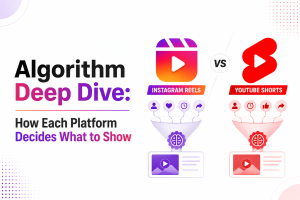
YouTube Shorts Algorithm: Built on Watch Time and Retention
YouTube’s algorithm for Shorts revolves around one core metric: average view duration — the percentage of your video that the average viewer actually watches before swiping away. When you publish a Short, it is shown to a small seed audience: a mix of existing subscribers and non-subscribers whose watch history suggests interest in your content. If retention is strong — ideally above 60%, with elite performers hitting 80% and above — YouTube expands distribution to progressively larger pools of non-subscribers.
This means the first two seconds of your Short decide its entire distribution fate. A weak hook does not just mean fewer views — it signals to the algorithm that your content does not hold attention. In 2026, viewer satisfaction surveys have become an increasingly important signal, with YouTube now weighting explicit feedback from viewers alongside raw watch time data.
Instagram Reels Algorithm: Built on Shareability and Trend Velocity
Instagram’s algorithm places significantly more weight on social actions — particularly shares via direct message (DM). When a viewer sends your Reel to a friend, the algorithm treats this as one of the strongest possible signals to expand distribution. This changes what ‘good content’ means on Instagram: on YouTube, good content holds someone’s attention. On Instagram, good content makes someone think of another specific person — ‘you have to see this.’
The second major lever is trending audio. Instagram actively boosts Reels that use rising sounds — but the window is narrow. The optimal time to use a trending sound is when it has traction in your niche but has not yet been used by millions globally. Spotting trends early — often on TikTok, where sounds gain momentum 3 to 7 days before migrating to Instagram — is a genuine competitive advantage.
Reach and Growth: Which Platform Builds an Audience Faster?
Instagram Reels: Fast Spikes, Trend-Dependent Growth
A well-executed Reel that taps into a trending sound and generates strong DM shares can reach hundreds of thousands of viewers within 24 to 48 hours — even with a small following. However, most Reels see the vast majority of their reach within the first 48 to 72 hours. After that, distribution drops sharply. Building an audience on Reels requires consistent publishing and consistent trend participation — you cannot coast on older content.
YouTube Shorts: Slower Burn, Compounding Long-Term Reach
YouTube Shorts take longer to build momentum, but the payoff is fundamentally different. Shorts are discoverable through YouTube’s search function — meaning a Short published today about a specific topic can continue attracting views six months from now, as long as people keep searching for that topic. For new creators, this search-based discovery is also more meritocratic: content quality and relevance matter more than existing subscriber count.
Audience Demographics: Who Are You Actually Reaching?
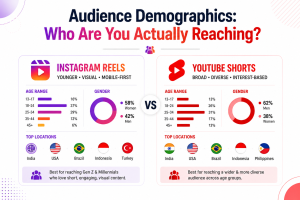
Instagram Reels Audience
Reels skews younger — core audience is broadly 18 to 35, mobile-first, and in a passive consumption mindset. They are scrolling for entertainment and inspiration, not searching for specific information. They respond to aesthetics, trends, humor, and relatable content. This audience makes Reels particularly powerful for product-based brands, lifestyle, fashion, food, and beauty categories where visual appeal drives purchase decisions.
YouTube Shorts Audience
YouTube’s Shorts audience is broader in age — spanning 16 to 50 and above — and more intent-driven. A significant portion of YouTube viewers arrive with a specific goal: learning something, solving a problem, or researching a topic. For brands in education, professional services, software, finance, and health, this intent-driven audience is often far more aligned with long-term business goals. A viewer who finds your Short while searching for an answer is far more likely to subscribe and eventually become a customer than a viewer who stumbled across your Reel while passively scrolling.
Monetization: Where Can You Actually Make Money in 2026?
YouTube Shorts Monetization
YouTube offers direct platform monetization through the YouTube Partner Program (YPP). Creators need 1,000 subscribers and either 10 million Shorts views in 90 days or 4,000 hours of long-form watch time to qualify. Once eligible, creators earn a share of ad revenue generated between Shorts. The real monetization power, however, lies in the broader ecosystem: Shorts serve as a discovery mechanism feeding viewers into long-form content, where CPMs are significantly higher and monetization options include memberships, merchandise, and course sales.
Instagram Reels Monetization
Instagram’s direct monetization for Reels has been inconsistent. The original Reels Play bonus program has been significantly scaled back, and Instagram does not offer a stable ad revenue sharing model comparable to YouTube’s YPP. The real monetization path on Instagram runs through brand partnerships, affiliate marketing, Instagram Shopping, and using Reels as a funnel toward your own products and services.
The Honest Monetization Summary
Neither platform is a quick revenue mechanism through views alone. YouTube offers the more stable, predictable direct revenue path — but requires hitting meaningful threshold numbers first. Instagram offers faster brand deal opportunities for the right creator profiles. For most creators and businesses, real monetization comes from treating both platforms as audience-building tools that funnel toward higher-value revenue streams: courses, products, services, and brand partnerships.
Content Production: What Each Platform Expects
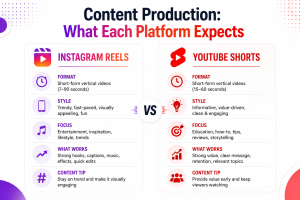
Production Standards on Instagram Reels
Instagram Reels carries higher visual expectations. Intentional framing, clean lighting, and consistent visual branding noticeably outperform hastily shot footage. Text overlays, captions for silent viewing, and smooth transitions are baseline expectations. Optimal length sits between 15 and 30 seconds for maximum completion rates, though tutorial content can work at 60 to 90 seconds if the value density justifies the length. The first three seconds are critical — up to half of all viewers drop off in the opening moments if the hook does not immediately capture attention.
Production Standards on YouTube Shorts
YouTube Shorts rewards substance over style. A slightly rough tutorial that delivers genuine value in 45 seconds will consistently outperform a polished video with no real insight. What matters technically is metadata: the title, description, and thumbnail. Because YouTube is a search engine, keyword research — identifying the actual phrases people are typing into search — is a legitimate competitive advantage that simply does not exist in the same way on Reels. If you are building a career in SEO or digital marketing and want to sharpen your fundamentals, our list of top 60 SEO interview questions for freshers is a practical place to start.
Platform Comparison at a Glance
| Factor | Instagram Reels | YouTube Shorts |
| Best Content | Trends, entertainment, lifestyle | Tutorials, education, evergreen |
| Algorithm Priority | DM shares, trending audio, engagement | Watch time, retention, satisfaction |
| Virality Speed | Fast — peaks in 24–48 hours | Slow — builds over weeks/months |
| Content Lifespan | Days to 1 week | Months to years |
| Audience Mindset | Passive scrolling, entertainment | Active searching, problem-solving |
| Age Demographics | 18–35 primary | 16–50+, broader range |
| Production Quality | Higher — polish matters | Value density > polish |
| Direct Monetization | Brand deals, Shopping | YPP ad revenue sharing |
| Follower Dependency | Moderate | Low — search levels field |
| SEO Value | Moderate (caption keywords) | High — title & description critical |
Which Platform Should You Choose?
Choose YouTube Shorts if:
- Your content is educational — tutorials, how-tos, explainers, tips, and industry insights
- You want content that keeps working months after you publish it
- You are building authority in a niche where trust and expertise matter
- You have or want a long-form YouTube presence and want Shorts to feed traffic to it
- You are starting with a small or zero following and want a level playing field
- You want direct, transparent platform monetization through YPP
Choose Instagram Reels if:
- Your content is visual, aesthetic, trend-driven, or entertainment-focused
- You need fast visibility — for a product launch, event, or short campaign window
- You are in fashion, beauty, food, travel, fitness, or a lifestyle niche
- You already have an Instagram following you want to engage and grow
- You want to build community through shareable, DM-worthy content
- Your primary revenue path is brand partnerships, affiliate links, or Instagram Shopping
The Real Answer: Both — But Staged
The most effective short-form video strategy in 2026 is a prioritized, phased approach. Pick the platform that best matches your content type and audience. Spend 6 to 12 weeks mastering that platform’s algorithm — understand what hooks work, what formats hold attention, and what topics consistently perform. Once you have a system that works on Platform A, adapt your best content for Platform B without copy-pasting it blindly. Each platform needs content optimized for its specific algorithm.
A Practical 4-Week Launch Plan
Week 1: Research Before You Record
Before creating a single piece of content, analyze what already works. Study 20 top-performing videos in your niche on your chosen primary platform. Look at what hooks they use in the first two to three seconds, how long they hold attention, what topics they cover, and what calls to action they use. Set up analytics tracking from day one.
Week 2–3: Build Your Content System
Map out 8 to 10 content ideas based on your research. Film in batches. On YouTube Shorts, invest time in keyword research for titles and descriptions. On Instagram Reels, monitor trending sounds daily and identify ones gaining momentum in your specific niche rather than globally.
Week 4 Onwards: Publish, Measure, Iterate
Post consistently — frequency matters less than reliability. Track the metrics the algorithm actually cares about: average view duration on YouTube, DM shares and saves on Instagram. Double down on what outperforms. Add your secondary platform only after you have a repeatable system working on the first.
Final Verdict
Instagram Reels and YouTube Shorts are both powerful platforms — but powerful in different ways, for different goals, and for different content types. Reels win on speed: the better platform for fast viral reach, trend-driven campaigns, and visual brand building. Shorts wins on staying power: the better platform for compounding discovery, search-based audience building, and long-term sustainable growth.
If you want to go deeper on short-form video strategy within a complete digital marketing framework, visit Digital Pundit to explore our Digital Marketing Course in Ahmedabad and resources. And if you are evaluating the best path to build a career in this space, read our breakdown of the best career course after graduation and the top skills companies are hiring for in 2026 — it covers exactly what employers in digital marketing are looking for right now.
The short-form video opportunity is real. The creators and brands who win it are the ones who understand the rules of each platform well enough to play them intentionally — not the ones who post the same content everywhere and hope for the best.