

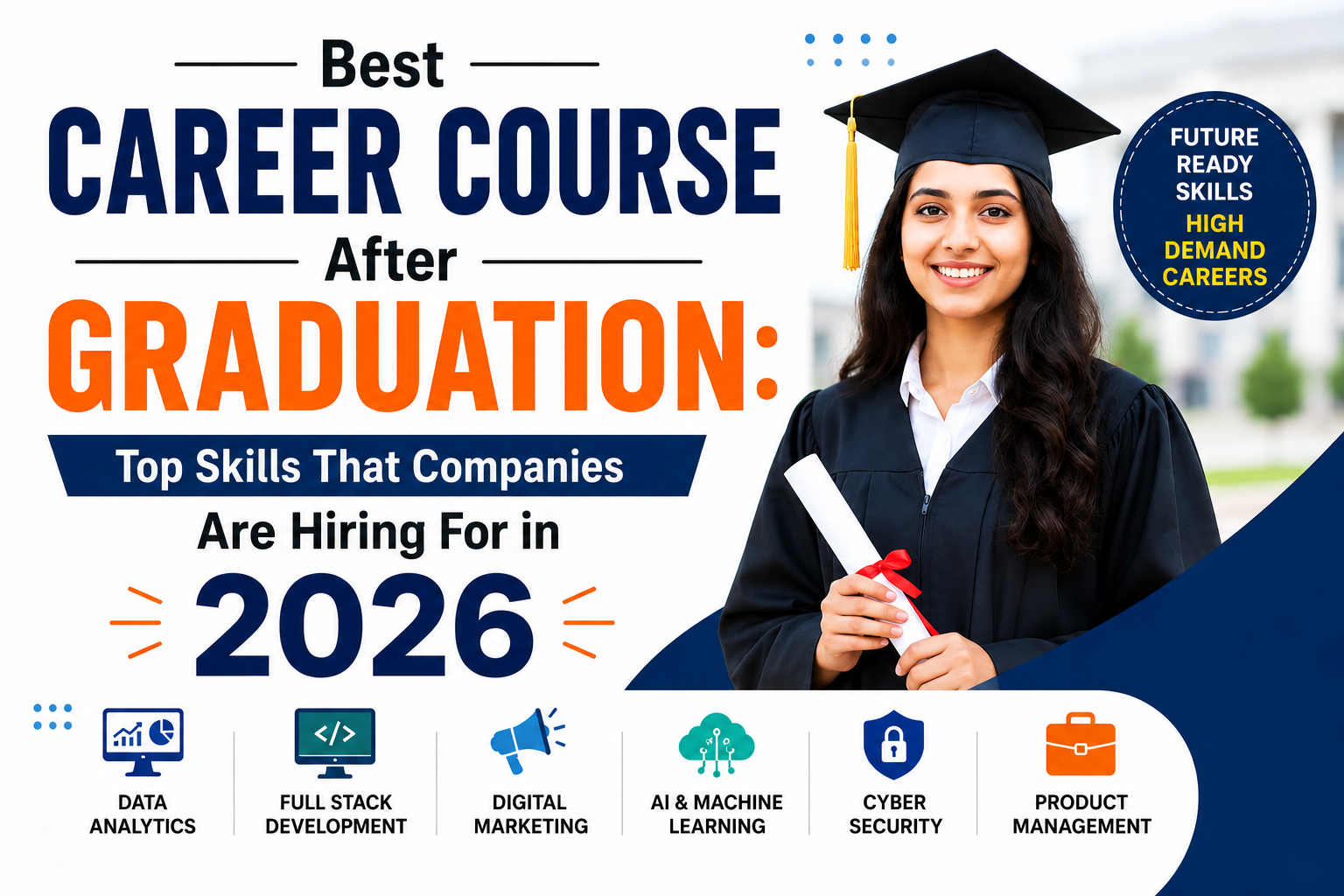
Graduating from college used to feel like crossing a finish line. In 2026, it feels more like a starting block. The job market has changed faster in the last few years than in the previous two decades, and a degree alone no longer guarantees a seat at the interview table. Employers today are far more interested in what you can actually do than in which university name sits on your certificate.
If you’re a fresh graduate (or about to become one) wondering which course to pick after graduation to actually land a job, this guide breaks down what’s really happening in the hiring market right now, and which skills are worth your time and money.
Why “Best Career Course After Graduation” Is the Wrong First Question
Before jumping into course names, it helps to understand why the hiring landscape has shifted. Employers are increasingly screening for skills, portfolios, and projects rather than degrees alone, and this skills-first approach to hiring has only accelerated through 2026. Reports from major hiring platforms show that a majority of employers now use skills-based hiring practices, a sharp rise from just a couple of years ago.
What this means practically: the “best” course isn’t a single universal answer. It’s the course that helps you build a demonstrable, in-demand skill that you can prove with real work, not just a certificate sitting in a folder. With that context, let’s look at the categories companies are actually hiring for.
1. AI and Machine Learning Literacy
There’s no getting around it: AI fluency has become one of the most valuable skills a graduate can have. This doesn’t mean every graduate needs to become a machine learning engineer. It means understanding how to work with AI tools, write effective prompts, evaluate outputs, and integrate AI into business workflows.
Roles built around AI and ML continue to see remarkable salary growth and year-over-year demand, with companies needing people who can adapt pre-trained models for real, production-ready use cases rather than building everything from scratch. Skills like retrieval-augmented generation (RAG) systems, AI workflow design, and responsible AI oversight are increasingly valued because companies need people who can validate and manage AI outputs, not just generate them.
Course recommendation: A short, project-based AI/ML or prompt engineering certification that results in a usable portfolio (chatbots, automation workflows, or AI-powered tools) will do more for your resume than a theory-heavy degree extension.
2. Data Analytics and Data Literacy
Data has quietly become the new literacy. Whether you’re in marketing, finance, healthcare, or operations, the ability to read data, draw insights, and make decisions based on it is now considered a baseline expectation rather than a specialized skill. Data scientist and data analyst roles continue to be among the fastest-growing job categories, and data fluency is increasingly treated as essential as knowing how to use email.
Course recommendation: Courses covering SQL, Python for data analysis, Excel-based analytics, and visualization tools like Power BI or Tableau give graduates a practical, job-ready edge across almost every industry.
3. Cybersecurity Fundamentals
As businesses digitize every part of their operations, the demand for cybersecurity professionals has only grown. Industry projections continue to point to a global shortage of millions of cybersecurity professionals, with strong hiring growth expected to continue through the rest of the decade. Even outside dedicated security roles, basic cybersecurity awareness is becoming a hiring differentiator across IT, finance, and operations roles.
Course recommendation: Entry-level cybersecurity certifications combined with hands-on labs (simulated attacks, network monitoring, basic ethical hacking) are excellent starting points, even for non-IT graduates who want to add a security layer to their resume.
4. Cloud Computing
Cloud platforms now run the backbone of most modern businesses. Cloud architecture and operations remain top priorities for business leaders heading into 2026, alongside IT infrastructure and data engineering. Graduates who understand the basics of cloud deployment, whether on AWS, Azure, or Google Cloud, are positioned well across software, IT, and even non-technical business roles that rely on cloud-based tools.
5. Digital Marketing
While AI, data, and cybersecurity dominate headlines, digital marketing remains one of the most accessible and consistently in-demand skill sets for graduates, especially those who don’t come from a core technical background. Every business, from local shops to multinational brands, now depends on digital channels to generate leads and revenue. This has created sustained demand for professionals skilled in SEO, social media marketing, paid advertising, content strategy, and marketing analytics.
What makes digital marketing especially attractive as a post-graduation course choice is the speed at which you can build a portfolio. Unlike many technical fields that require months of foundational learning before you can show real output, digital marketing skills can be applied almost immediately to real campaigns, websites, and social accounts, giving graduates tangible proof of their abilities within weeks.
If you’re based in Gujarat or considering relocating for opportunities, enrolling in a digital marketing course in Ahmedabad is a practical way to combine affordable, locally accessible training with hands-on exposure to live projects, client work, and industry tools. Ahmedabad has grown into a genuine hub for marketing and IT-enabled businesses, which means graduates trained locally often get a head start on internships and entry-level roles within the same ecosystem.
It’s also worth noting that digital marketing pairs exceptionally well with the other skills mentioned above. A marketer who understands data analytics can measure campaign performance with precision. A marketer who understands AI tools can automate content creation and audience targeting. This kind of “skill stacking”, combining a core skill with adjacent capabilities, is exactly what recruiters are increasingly drawn to.
6. Soft Skills: The Quiet Differentiator
Here’s something graduates often underestimate: technical skills get you shortlisted, but soft skills get you hired and promoted. Soft skills now account for a majority of the fastest-growing skills globally, with conflict resolution, public speaking, communication, adaptability, and stakeholder management ranking alongside technical capabilities in importance. A large body of research also shows that workers with strong foundational soft skills tend to earn higher wages and advance into more senior roles over time.
This doesn’t mean you need a separate “course” for soft skills necessarily, but it does mean that whatever course you choose should include real communication, teamwork, and presentation components, not just solo, self-paced video lessons.
7. Green and Sustainability Skills
An emerging but fast-growing category worth watching is sustainability and ESG (Environmental, Social, and Governance) skills. Green hiring has been outpacing the supply of trained professionals across finance, technology, and utilities sectors. While this is still a smaller niche compared to tech and marketing, graduates with an interest in sustainability, supply chains, or corporate strategy may find strong long-term opportunities here.
How to Actually Choose: A Practical Framework
With so many options, here’s a simple way to decide:
- Start with one skill, not five. Spreading yourself across AI, cybersecurity, and marketing simultaneously usually leads to shallow knowledge in all three. Pick one direction that genuinely interests you.
- Prioritize project-based learning over passive video courses. Employers want proof, not certificates. Build something real: a campaign, a dashboard, a small app, a case study.
- Choose practical, local training where possible. Courses that offer live mentorship, internships, or placement support (rather than purely self-paced online content) tend to translate into job offers faster.
- Stack a soft skill alongside your technical one. Communication and adaptability multiply the value of every technical skill you learn.
- Keep learning after the course ends. The skills gap is real, but it rewards people who treat learning as ongoing rather than a one-time event after graduation.
Final Thoughts
The job market in 2026 doesn’t reward credentials for their own sake, it rewards demonstrated ability. Whether you choose to specialize in AI, data, cybersecurity, cloud, or digital marketing, the underlying principle is the same: build something real, show your work, and keep adapting.
For graduates looking to break into one of the most accessible, fast-moving, and consistently in-demand fields, digital marketing remains a strong starting point, particularly when paired with structured, hands-on training. If you’re exploring your options and want to understand why even great products and services sometimes fail to convert online, this related read on why your website isn’t generating leads and how to fix it in 2026 is a useful companion piece that connects directly to the kind of practical, results-driven thinking employers want from digital marketers today.
Whatever path you choose, treat your post-graduation course as your first real-world project, not just another line on your resume. The graduates who thrive in 2026 are the ones who can show, not just tell, what they’re capable of.