

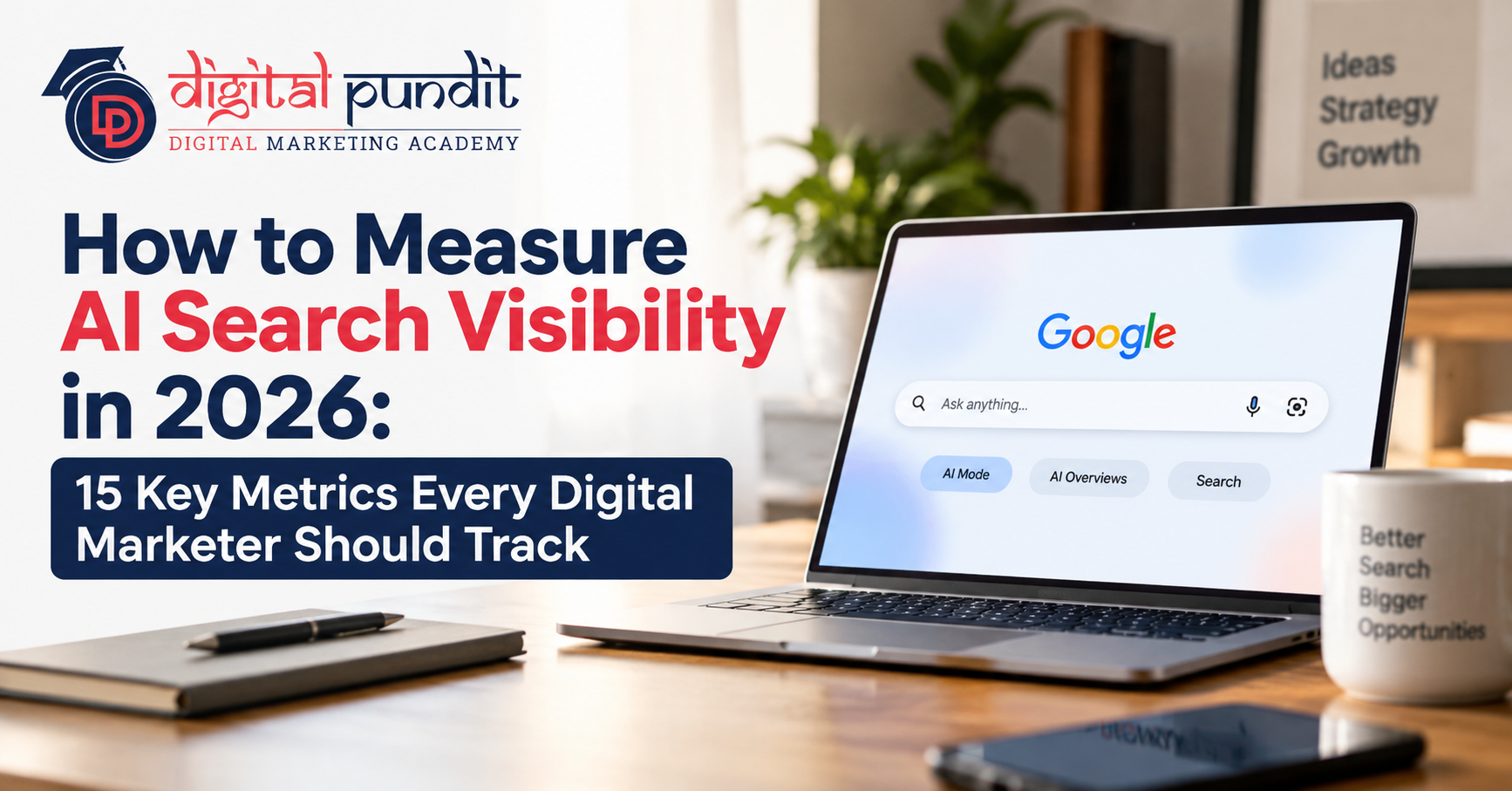
How to Measure AI Search Visibility in 2026: 15 Metrics Every Digital Marketer Should Track
For years, measuring SEO performance was relatively straightforward.
You looked at keyword rankings, impressions, clicks, CTR, organic traffic, backlinks and conversions.
Then search started changing.
People are increasingly asking longer, conversational questions. Google is generating AI-powered answers. ChatGPT is being used to discover information, products and businesses. Microsoft Copilot and Bing are also surfacing websites inside AI-generated responses.
Suddenly, a business can be visible without necessarily holding a traditional position 1, 2 or 3.
And that creates a new question for marketers:
How do you measure visibility when the search result itself is generated by AI?
The answer isn’t to throw traditional SEO metrics away.
Instead, marketers need to combine AI-specific visibility signals with traditional search, traffic and business metrics.
Google’s current Search Console now provides a dedicated Generative AI performance report covering AI Overviews and AI Mode, while Bing Webmaster Tools provides an AI Performance report showing citations, cited pages and grounding-query information across supported Microsoft AI experiences.
Let’s break down the 15 metrics that matter.
What Is AI Search Visibility?
AI search visibility is the extent to which your website, brand, products, services or content appear, are referenced, cited or linked when users search through AI-powered search experiences.
This can happen in several ways.
Your website might:
- Appear as a cited source in an AI answer
- Receive a link from an AI-generated response
- Be mentioned as a brand or business
- Generate a click from an AI search experience
- Appear in Google AI Overviews
- Appear in Google AI Mode
- Be cited by Microsoft Copilot
- Receive referral traffic from ChatGPT
- Influence an AI-generated answer without receiving a click
That last point is particularly important.
A zero-click visit doesn’t necessarily mean zero visibility.
AI search makes visibility harder to measure because not every appearance produces a traditional website visit.
Traditional SEO vs AI Search Measurement
Before getting into the 15 metrics, it helps to understand the difference.
| Traditional SEO | AI Search |
|---|---|
| Keyword rankings | AI citations |
| Search impressions | AI feature impressions |
| Organic clicks | AI referral clicks |
| CTR | AI citation/appearance rate |
| Average position | Citation presence |
| Backlinks | Brand/entity mentions |
| Organic traffic | AI referral traffic |
| Featured snippets | AI-generated answers |
| Keyword visibility | Prompt/query visibility |
| Conversions | Assisted conversions |
| SERP features | AI answer inclusion |
The two aren’t competing systems.
In fact, Google explicitly says that existing SEO best practices remain relevant for its generative AI search experiences. Google also says there are no additional technical requirements or special schema required specifically for AI Overviews or AI Mode.
So the goal isn’t to replace SEO.
The goal is to expand your measurement framework.
15 Metrics to Measure AI Search Visibility
1. AI Search Impressions
Let’s start with the most important new metric: AI impressions.
An AI impression indicates that a URL from your website was shown within a generative AI feature.
Google’s Generative AI performance report currently provides impression data for AI Overviews and AI Mode, including breakdowns by page, country, device and date.
This gives marketers a much clearer answer to:
Is my website actually appearing in Google’s AI search experiences?
For example:
| Month | AI Impressions |
|---|---|
| January | 12,400 |
| February | 15,800 |
| March | 21,300 |
An increase doesn’t automatically mean more revenue, but it indicates growing exposure within Google’s generative search features.
2. AI-Cited Pages
Not every page on your website will perform equally in AI search.
Some pages may repeatedly become sources for AI-generated answers while others receive little or no visibility.
That’s why you should monitor which URLs are being cited.
Google’s report allows you to analyze pages appearing in generative AI features. Bing’s AI Performance report similarly provides page-level citation activity.
Create a report like this:
| Page | AI Citations | Organic Clicks | Conversions |
|---|---|---|---|
| Digital Marketing Course | 125 | 2,850 | 42 |
| SEO Course | 82 | 1,940 | 27 |
| Google Ads Guide | 61 | 1,420 | 19 |
This can reveal something interesting.
A page that isn’t your biggest traffic generator might actually be one of your strongest AI visibility assets.
3. AI Search Referral Traffic
Visibility is useful.
Traffic is better.
Use Google Analytics or another analytics platform to identify traffic coming from AI platforms and AI-driven search experiences where the referral information is available.
Look at sources such as:
- ChatGPT
- Bing/Copilot-related referrals
- Other AI discovery platforms
- AI-generated search experiences
For ChatGPT specifically, OpenAI states that public websites can appear in ChatGPT Search and recommends allowing OAI-SearchBot to crawl content that you want discovered, surfaced and cited.
Track:
AI referral sessions → engaged sessions → leads → sales
That’s much more useful than simply counting mentions.
4. AI Citation Frequency
One of the most useful questions for an SEO team is:
How often is our content being cited?
Bing’s AI Performance report provides a Total Citations metric showing how often site content was visibly referenced in supported AI-generated answers.
For example:
| Period | Citations |
|---|---|
| January | 210 |
| February | 275 |
| March | 348 |
A rising citation trend can indicate that your content is increasingly being used as a source within supported AI experiences.
But don’t treat citations as a ranking position.
Bing specifically notes that citation counts do not indicate ranking, authority, importance or the role of a page within an individual answer.
5. AI Query or Grounding-Query Visibility
Traditional SEO asks:
Which keywords am I ranking for?
AI search requires a slightly different question:
Which questions or topics are causing AI systems to use my content?
Bing’s AI Performance report includes grounding queries, which are grouped phrases associated with content retrieved and cited in AI answers. These aren’t necessarily the exact prompts users typed.
For example, your content might repeatedly appear around topics such as:
- best digital marketing course
- SEO training for beginners
- Google Ads certification
- digital marketing career
- SEO vs PPC
This helps you identify topic-level AI visibility, rather than relying only on traditional keywords.
6. AI Visibility by Topic
Don’t measure AI visibility only page by page.
Measure it by topic cluster.
Suppose you have 30 articles around SEO.
You can group them into:
- Technical SEO
- Local SEO
- Ecommerce SEO
- AI SEO
- Keyword research
- Link building
Then measure how much AI visibility each cluster receives.
| Topic | Pages | AI Citations | AI Impressions |
|---|---|---|---|
| Technical SEO | 8 | 185 | 31,200 |
| AI SEO | 6 | 240 | 42,500 |
| Local SEO | 7 | 95 | 16,800 |
| Link Building | 9 | 72 | 12,400 |
Now you aren’t just asking:
Which page is performing?
You’re asking:
Which subjects does AI associate with our website?
That’s a much more strategic question.
7. Brand Mentions in AI Answers
AI visibility isn’t limited to links.
Sometimes the AI system mentions your:
- Brand
- Product
- Service
- Founder
- Company
- Location
- Tool
- Course
without linking directly to your website.
This is why marketers should regularly test important commercial and informational questions across major AI experiences.
For example:
What are the best digital marketing institutes in Ahmedabad?
or:
What should a beginner learn before starting Google Ads?
Record:
- Was your brand mentioned?
- Was your website cited?
- Which competitors appeared?
- What description was used?
- Was the information accurate?
This creates an AI brand visibility log.
8. Citation Share
Another useful way to think about AI visibility is citation share.
Imagine an AI response cites five websites.
If your website appears among those sources, you have citation presence.
Now repeat that exercise across a large set of relevant queries.
You can calculate:
Citation Share = Queries where your site is cited ÷ Total tracked queries × 100
For example:
500 tracked prompts
75 prompts cite your website
Citation Share = 15%
This isn’t an official universal industry metric, but it can be a useful internal KPI when you consistently measure the same query set.
Bing is also introducing a Citation Share capability in its AI Performance reporting, designed to provide relative citation presence for grounding queries.
9. Competitor AI Visibility
SEO has always involved competitor analysis.
AI search is no different.
Build a competitor comparison for your most important topics.
| Brand | AI Mentions | Citations | Referral Traffic |
|---|---|---|---|
| Your Brand | 42 | 31 | 680 |
| Competitor A | 55 | 39 | 920 |
| Competitor B | 28 | 21 | 410 |
Don’t treat this as a universal ranking.
AI responses can change based on the query, location, language, device, model and time.
Instead, use competitor tracking to identify visibility gaps.
If competitors consistently appear for a topic where your business has strong expertise, investigate why.
10. AI-Assisted Conversions
This is where measurement becomes meaningful for business owners.
Getting cited is nice.
Getting customers is better.
Track whether AI-discovered users eventually:
- Submit a lead form
- Call your business
- Buy a product
- Book a consultation
- Register for a course
- Subscribe
- Download a resource
For example:
| Source | Sessions | Leads | Conversion Rate |
|---|---|---|---|
| Google Organic | 10,000 | 420 | 4.2% |
| ChatGPT | 850 | 58 | 6.8% |
| Bing/Copilot | 420 | 21 | 5.0% |
This tells you something traditional visibility reports cannot.
Which discovery channel is producing business value?
Google has also advised site owners to look beyond clicks and evaluate outcomes such as sales, signups and other conversion indicators when assessing search traffic.
11. Engagement Quality of AI Traffic
Don’t assume every visit is equally valuable.
Compare AI-referred users with traditional organic visitors.
Look at:
- Engagement rate
- Average engagement time
- Pages per session
- Returning users
- Lead completion
- Purchases
- Newsletter subscriptions
Google has reported that clicks from search result pages with AI Overviews can be higher quality, with users more likely to spend more time on sites. That’s Google’s observation, not a guarantee for every website.
Your own analytics should ultimately determine whether that’s true for your audience.
12. AI Visibility by Country and Device
AI search behaviour isn’t identical everywhere.
A page may have strong AI visibility in India but limited visibility in the US.
Or it might perform well on mobile but not desktop.
Google’s Generative AI performance report allows analysis by country and device, along with page and date dimensions.
This matters particularly for:
- Ecommerce brands
- Local businesses
- International SEO
- SaaS companies
- Education businesses
- Travel websites
Instead of saying:
Our website has good AI visibility.
You can say:
Our AI visibility is strongest for these topics, pages and markets.
That’s much more actionable.
13. AI Visibility Trend Over Time
One screenshot doesn’t tell you much.
AI search results can change.
Models change. Search interfaces change. Content changes. Competitors publish new information. User behaviour changes.
So track AI visibility monthly.
A simple dashboard might look like:
| Month | AI Impressions | Citations | AI Traffic | Leads |
|---|---|---|---|---|
| Jan | 12,400 | 210 | 320 | 18 |
| Feb | 15,800 | 275 | 410 | 24 |
| Mar | 21,300 | 348 | 680 | 39 |
The trend is more useful than a single number.
Bing’s AI Performance reporting also provides a timeline for citation activity and explicitly cautions that changes cannot automatically be attributed to one specific update, model change or content modification.
14. Accuracy of Your Brand’s AI Representation
Here’s a metric marketers often forget.
Is AI getting your business right?
Your brand could be mentioned frequently while the information is wrong.
Check whether AI systems correctly understand:
- Your products
- Your services
- Pricing
- Locations
- Business hours
- Course details
- Features
- USPs
- Company expertise
- Contact information
Create a simple accuracy score internally.
For example:
| Information | Correct? |
|---|---|
| Brand description | ✅ |
| Services | ✅ |
| Location | ✅ |
| Pricing | ❌ |
| Contact details | ✅ |
| Product features | ✅ |
You don’t want high AI visibility with inaccurate brand information.
Visibility without accuracy can create a reputation problem.
15. Organic Traffic and Revenue After AI Search Exposure
Finally, connect everything back to the business.
Your AI visibility dashboard shouldn’t end with:
AI impressions: 50,000
It should eventually answer:
What happened because we became more visible?
Track the full journey:
AI Visibility → Website Visit → Engagement → Lead → Customer → Revenue
For an ecommerce business:
AI citation → product visit → add to cart → purchase
For an education business:
AI mention → course page → enquiry → counselling call → admission
For a B2B company:
AI citation → service page → consultation → qualified lead → deal
That’s where AI search measurement becomes a marketing function rather than just an SEO experiment.
The AI Search Visibility Measurement Framework
Here’s a practical framework you can use for your monthly reporting:
| Category | Metrics to Track |
|---|---|
| Visibility | AI impressions, AI appearances |
| Citations | Citation count, cited pages |
| Queries | Grounding queries, tracked prompts |
| Brand | Brand mentions, entity visibility |
| Competition | Competitor mentions, citation share |
| Traffic | AI referral sessions |
| Engagement | Engagement rate, time, pages/session |
| Conversions | Leads, purchases, signups |
| Revenue | AI-assisted revenue |
| Geography | Country-level visibility |
| Devices | Mobile vs desktop |
| Content | Best-performing AI-cited pages |
| Accuracy | Correct vs incorrect brand information |
| Trends | Monthly visibility changes |
| Business Impact | Revenue and qualified leads |
Which Tools Should You Use?
You don’t need 15 different subscriptions to begin.
Start with the tools you already have.
1. Google Search Console
This should be your first stop for Google AI visibility.
As of August 31, 2026, Google’s dedicated Generative AI performance report has rolled out worldwide and includes AI Overviews and AI Mode. It provides impressions and page-level analysis, with country, device and date dimensions available.
2. Google Analytics
Use GA4 to understand what happens after someone reaches your website.
Look at:
- AI referral traffic
- Engagement
- Landing pages
- Conversions
- Revenue
3. Bing Webmaster Tools
Bing’s AI Performance report provides visibility into citations across Microsoft Copilot, AI-generated summaries in Bing and selected partner experiences. It includes cited pages, citation activity and grounding queries.
4. Manual AI Prompt Tracking
This is still useful.
Create a fixed list of important prompts and check them periodically across relevant AI search experiences.
For example:
- Best digital marketing course in Ahmedabad
- Best SEO course for beginners
- How to learn Google Ads
- Digital marketing career options
- Best PPC training institute
Record what happens.
Don’t change your prompt every time.
Consistency is what makes the comparison useful.
5. Your CRM
This is where AI visibility becomes a revenue metric.
Ask leads:
How did you find us?
If possible, add:
- ChatGPT
- AI search
- Social media
- Referral
- Other
The data won’t be perfect, but it can reveal useful patterns.
A Simple Monthly AI Search Report
If you’re managing SEO for a business, your monthly report could contain just one table:
| KPI | Previous Month | Current Month | Change |
|---|---|---|---|
| AI Impressions | 15,800 | 21,300 | +34.8% |
| AI Citations | 275 | 348 | +26.5% |
| Cited Pages | 42 | 57 | +35.7% |
| AI Referral Traffic | 410 | 680 | +65.9% |
| AI Leads | 24 | 39 | +62.5% |
| AI-Assisted Revenue | ₹1.8L | ₹2.7L | +50% |
Then add three short observations:
What improved?
AI visibility increased across informational content.
What declined?
Commercial pages received fewer AI citations.
What should we do next?
Strengthen commercial content and expand the topic clusters generating AI visibility.
That’s a report a business owner can actually understand.
What AI Search Visibility Does NOT Tell You
This is important because AI measurement is still developing.
A high citation count does not automatically mean:
- Your content ranks #1
- Your website is more authoritative
- You will receive more traffic
- Your competitors are performing worse
- Your revenue will increase
- Your content will be cited for every relevant query
Bing explicitly states that its citation data reflects citation activity and does not indicate ranking, authority or importance.
Similarly, Google’s generative AI report focuses on impressions within supported AI features rather than providing a universal AI-search ranking score.
This is why no single AI visibility score should become your north-star KPI.
Don’t Abandon Traditional SEO
There’s a temptation to think:
AI search is here, so traditional SEO doesn’t matter anymore.
That’s not what the current evidence or Google’s guidance suggests.
Google says AI Overviews and AI Mode are built on its core Search systems, and pages need to be indexed and eligible for Search to be considered as supporting links. Google also continues to recommend foundational SEO practices such as crawlability, internal linking, useful content, page experience and accessible text.
So your strategy should look more like this:
Traditional SEO
↓
Strong content + technical foundation
↓
AI search visibility
↓
Traffic + engagement
↓
Leads + revenue
Not:
SEO vs AI
But:
SEO + AI Search Measurement
The Bigger Shift: From Rankings to Visibility
For a long time, SEO reports revolved around one question:
Where do we rank?
That’s still useful.
But in 2026, the better question is:
How visible is our brand throughout the search journey?
A potential customer might:
- Search on Google.
- Read an AI Overview.
- Ask a follow-up question in AI Mode.
- See your brand mentioned.
- Visit your website.
- Compare you with competitors.
- Return through another channel.
- Eventually become a customer.
If your reporting only counts the final organic click, you’re missing part of that journey.
AI search doesn’t eliminate measurement.
It makes measurement more multidimensional.
Final Takeaway
AI search visibility is still an evolving measurement discipline.
There isn’t one universal number that tells you whether your brand is winning in AI search.
Instead, build a measurement system around 15 signals:
- AI impressions
- AI-cited pages
- AI referral traffic
- Citation frequency
- Grounding-query visibility
- Topic visibility
- Brand mentions
- Citation share
- Competitor visibility
- AI-assisted conversions
- Engagement quality
- Country and device visibility
- Visibility trends
- Brand-information accuracy
- Revenue and business impact
The biggest mistake would be to chase every new AI metric without understanding what it means for the business.
Track visibility. Track traffic. Track conversions. Track revenue.
And most importantly, keep creating content that genuinely deserves to be found.
Google’s current guidance puts particular emphasis on unique, valuable, non-commodity, people-first content rather than special AI-only tricks.
Because the future of search isn’t simply about being ranked. learn AI based digital marketing course at Digital Pundit.
It’s about being found, understood, referenced and trusted wherever your customers choose to search.