

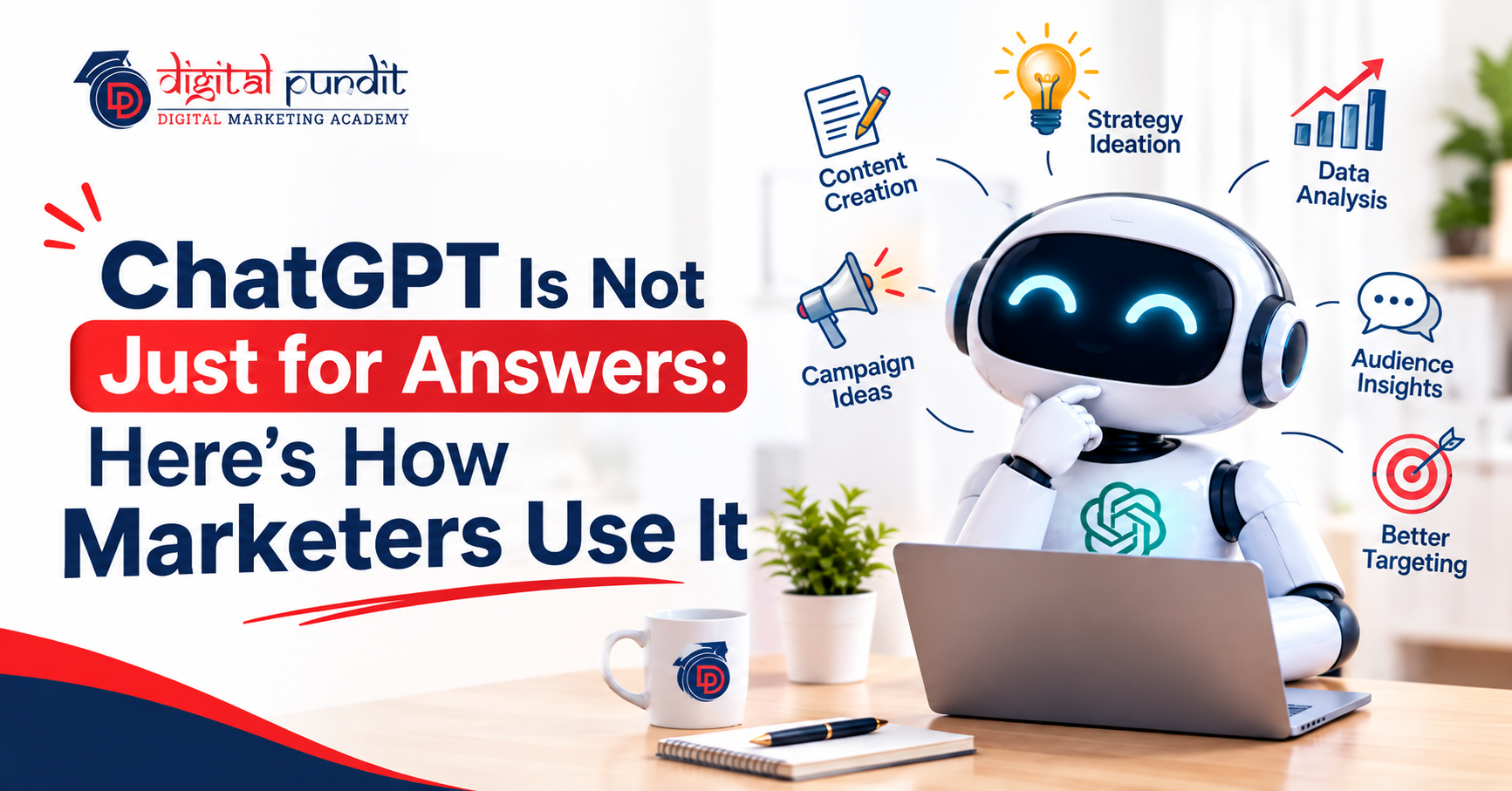
ChatGPT has quickly become one of the most useful AI tools for people working in digital marketing. While many people still use it mainly to ask questions, write messages, or summarize information, marketers are using it for much more. From brainstorming campaigns and creating content to researching audiences, improving SEO strategies, and analyzing ideas, ChatGPT can support several stages of the marketing process. For students who are exploring a digital marketing course, learning how to use AI tools such as ChatGPT can provide a practical advantage and help them understand how modern marketing workflows are evolving.
The important point is that ChatGPT does not replace marketing knowledge. Instead, it can help marketers work faster, explore more ideas, and reduce the time spent on repetitive tasks. When combined with human creativity, strategy, research, and decision-making, AI can become a powerful marketing assistant.
What Is ChatGPT and Why Does It Matter for Marketers?
ChatGPT is an AI-powered conversational tool that can understand natural-language instructions and generate responses based on the context provided by the user. Marketers can interact with it using prompts to brainstorm ideas, organize information, draft content, develop campaign concepts, and perform many other tasks.
Traditional marketing often involves spending significant time on repetitive activities. A marketer may need to generate multiple headline ideas, create social media variations, prepare email drafts, organize keyword concepts, or develop different versions of an advertisement.
ChatGPT can help accelerate these processes.
However, there is an important distinction between using AI to produce content and using AI strategically.
A beginner might simply type:
“Write an Instagram caption for a clothing brand.”
A marketer can provide much more useful context:
“Create five Instagram captions for a premium sustainable clothing brand targeting urban professionals aged 25–35. Keep the tone sophisticated, avoid exaggerated claims, and include a soft call to action.”
The second approach gives the AI clearer direction and produces output that is more relevant to an actual marketing objective.
That is why learning how to communicate effectively with AI is becoming an important digital marketing skill.
1. ChatGPT for Marketing Research
Before creating a campaign, marketers need to understand their audience.
They need to know:
- Who are their potential customers?
- What problems do they face?
- What questions do they ask?
- What motivates them to buy?
- What objections might prevent a purchase?
- What type of content attracts their attention?
ChatGPT can help marketers organize and explore these questions.
For example, a marketer promoting a fitness program could ask ChatGPT to create different customer personas based on a specific target audience. The marketer can then explore possible pain points, questions, motivations, and content interests for each persona.
This does not mean AI research should automatically be treated as factual customer research. Real customer data, surveys, reviews, analytics, and market research remain important.
Instead, ChatGPT can be used as a brainstorming and planning assistant.
2. Creating Content Ideas
One of the biggest challenges for digital marketers is consistently coming up with fresh content.
A business may need content for:
- Blogs
- YouTube
- Email campaigns
- Short-form videos
- Advertisements
ChatGPT can help generate content ideas around a particular topic.
For example, instead of asking:
“Give me social media ideas.”
a marketer could provide the industry, audience, platform, objective, and tone.
ChatGPT can then generate possible content pillars, campaign themes, post concepts, video hooks, educational topics, and promotional ideas.
The marketer still decides which ideas fit the brand.
This is particularly useful for businesses that struggle with content consistency.
3. ChatGPT for Blog Writing and SEO
SEO is another area where ChatGPT can support marketers.
It can help with tasks such as:
- Brainstorming blog topics
- Creating content outlines
- Developing FAQs
- Finding related topic ideas
- Improving headings
- Creating title variations
- Developing meta description ideas
- Simplifying complicated explanations
- Identifying potential search intent questions
For example, if a website sells online fitness programs, ChatGPT could help generate content ideas around beginner workouts, nutrition questions, home exercise, fitness equipment, and related topics.
But marketers should not simply publish AI-generated articles without reviewing them.
Good SEO content still requires original value, accurate information, appropriate search intent, useful examples, strong structure, and a clear understanding of the audience.
AI can help with the process, but the marketer remains responsible for quality.
4. Using ChatGPT for Social Media Marketing
Social media marketers constantly need new ideas and variations.
ChatGPT can help create:
- Instagram captions
- Reel hooks
- Carousel concepts
- LinkedIn post ideas
- Content calendars
- Story ideas
- Poll questions
- Call-to-action variations
- Promotional copy
For example, a restaurant could use ChatGPT to develop a week’s worth of social media concepts around a new menu.
Rather than creating seven similar promotional posts, a marketer could ask for different content angles:
Educational: Explain the ingredients.
Emotional: Tell the story behind the dish.
Entertainment: Create a relatable food-related reel.
Promotional: Highlight a limited-time offer.
Engagement: Ask followers to choose between two dishes.
This makes the content strategy more varied.
5. ChatGPT for Advertising Copy
Paid advertising requires concise and persuasive communication.
Marketers often need multiple versions of:
- Headlines
- Primary text
- Descriptions
- Calls to action
- Promotional messages
- Landing-page copy
ChatGPT can generate variations quickly.
For example, instead of creating one advertisement headline, a marketer can request ten versions based on different angles such as affordability, convenience, urgency, quality, or a specific customer problem.
The marketer can then test different variations.
This is especially useful because advertising performance depends on factors beyond copywriting, including targeting, offer, creative, landing page, budget, and campaign setup.
AI-generated copy is therefore only one part of the process.
6. ChatGPT for Email Marketing
Email marketing often requires personalization and multiple versions of the same message.
ChatGPT can help marketers draft:
- Welcome emails
- Promotional emails
- Product announcements
- Follow-up emails
- Newsletter ideas
- Abandoned-cart messages
- Event invitations
For example, a marketer could ask ChatGPT to create three versions of an email:
one professional, one friendly, and one concise.
This allows marketers to explore different communication styles quickly.
However, marketers should still check every email for accuracy, brand voice, personalization, and compliance with applicable marketing rules.
7. ChatGPT for Video Marketing
Short-form video has become an important part of digital marketing.
Creating videos often begins with a simple idea, but turning that idea into a structured script can take time.
ChatGPT can help marketers develop:
- Video hooks
- Reel scripts
- YouTube outlines
- Educational video concepts
- Product demonstration scripts
- Storytelling structures
- Voice-over scripts
- Calls to action
For example, a marketer promoting a digital marketing institute could ask ChatGPT for a 30-second video script explaining why students should learn AI-powered marketing skills.
The marketer can then adapt the script to match the brand’s personality and audience.
8. ChatGPT for Customer Personas
Understanding customers is essential for effective marketing.
ChatGPT can help marketers create hypothetical customer personas by organizing information such as:
Age: 18–25
Interest: Technology and entrepreneurship
Goal: Learn practical skills
Challenge: Limited experience
Content preference: Short videos and practical tutorials
These personas can help marketers think about how different audiences might respond to content.
But personas should ideally be supported by real customer information whenever possible.
Analytics, customer interviews, surveys, reviews, and sales data provide stronger evidence than assumptions alone.
9. ChatGPT for Marketing Strategy Brainstorming
Marketing is not simply about creating posts.
A marketer needs to think about the entire customer journey.
For example:
Awareness → Interest → Consideration → Conversion → Retention
ChatGPT can help brainstorm ideas for each stage.
At the awareness stage, the marketer may need educational content.
At the consideration stage, comparisons, case studies, demonstrations, and FAQs may be useful.
At the conversion stage, offers, testimonials, landing pages, and strong calls to action can become important.
This helps marketers look beyond individual posts and think about the complete marketing funnel.
10. ChatGPT and Prompt Engineering
One of the most valuable skills for marketers working with AI is learning how to write effective prompts.
A useful prompt usually provides context.
Instead of saying:
“Write a blog about SEO.”
a marketer could say:
“Write a beginner-friendly 1,500-word blog about SEO for small business owners. Explain the difference between on-page and off-page SEO, include practical examples, maintain a professional but conversational tone, and structure the article with clear H2 headings.”
The second prompt gives the AI a much clearer task.
Marketers can improve prompts by specifying:
- Role
- Objective
- Audience
- Context
- Tone
- Format
- Restrictions
- Examples
- Desired output
The better the input, the more useful the output is likely to become.
11. What ChatGPT Cannot Replace
Despite its capabilities, ChatGPT should not be treated as a complete replacement for a digital marketer.
Marketing requires human judgment.
A marketer must understand:
- Brand positioning
- Consumer psychology
- Business objectives
- Competition
- Market trends
- Customer behavior
- Creative strategy
- Campaign performance
- Data interpretation
AI can suggest ideas, but marketers must decide whether those ideas actually make business sense.
There is also the risk of inaccurate or generic information. AI-generated content can sound convincing while still requiring fact-checking and human review.
The strongest approach is therefore not AI versus humans.
It is AI + human expertise.
12. How Students Can Start Learning AI for Marketing
Students do not need to become AI engineers to start using AI in digital marketing.
They can begin with practical applications.
Start by learning how to use ChatGPT for content brainstorming, SEO research, social media planning, advertising copy, email campaigns, and marketing strategy.
Then explore other AI-powered tools for areas such as image creation, video production, analytics, automation, and search.
Most importantly, students should practice using AI on realistic marketing projects.
For example, they could create a complete campaign for a fictional business:
- Research the target audience.
- Create customer personas.
- Develop a content strategy.
- Generate social media ideas.
- Write advertisement variations.
- Create an email campaign.
- Develop a landing-page structure.
- Build a content calendar.
- Analyze the campaign concept.
- Improve the strategy based on performance data.
This type of hands-on practice can help students understand how AI fits into real marketing workflows.
Conclusion
ChatGPT is much more than a tool for getting quick answers. For marketers, it can act as a brainstorming partner, content assistant, research helper, strategy-support tool, and productivity assistant. Digital Pundit can help learners understand how these AI capabilities connect with practical digital marketing skills, from content and SEO to social media and advertising.
The important thing is to learn digital marketing alongside AI, rather than treating AI as a replacement for marketing knowledge. A strong digital marketing course can provide the foundation, while tools such as ChatGPT can help students apply those skills faster and explore new ways of working. As AI continues to influence how people search, create content, advertise, and interact with brands, marketers who know how to combine technology with strategy will be better prepared for the changing digital landscape.